



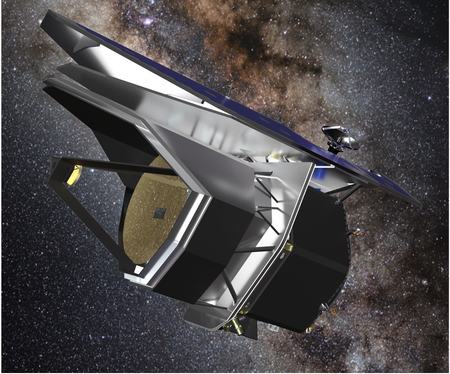
NASA has selected the far-infrared space telescope PRIMA as its Probe mission. It will be the first space telescope with an actively cooled mirror, at 4.5 degrees Kelvin. This reduces noise to such an extent that PRIMA is one thousand to one hundred thousand times more sensitive than its predecessors. SRON, TU Delft, and the University of Groningen plan to deliver the detectors, housing, and insulation of the PRIMAger instrument.
Month: September 2026
SRON demonstrates backup technology for NewAthena’s X-IFU instrument
SRON has built an array of 1,504 transition-edge sensors (TES) to provide a backup detector for NewAthena’s X-IFU instrument. It also lays the groundwork for the detection technology of the next-generation of European X-ray telescopes. X-IFU is the imaging spectrometer onboard ESA’s next flagship X-ray observatory NewAthena, to be launched around 2037.
SRON develops machine-learning method to quantify methane plume emission rates
SRON has been detecting methane plumes in TROPOMI data using machine-learning for a few years. Quantifying their emission rates is done operationally using a conventional approach. Now, in addition to this, SRON’s methane team publishes a new machine-learning method that quantifies plumes with a reduced error margin.

SRON and CNES define joint interests in Earth Observation
After signing a Letter of Intent last year during the Netherlands-France economic year, SRON and CNES have defined their joined interests in a white paper. In collaboration with national research partners. They will collaborate on monitoring greenhouse gases, air quality, key pollutants and aerosols.