



SRON has been detecting methane plumes in TROPOMI data using machine-learning for a few years. Quantifying their emission rates is done operationally using a conventional approach. Now, in addition to this, SRON’s methane team publishes a new machine-learning method that quantifies plumes with a reduced error margin.
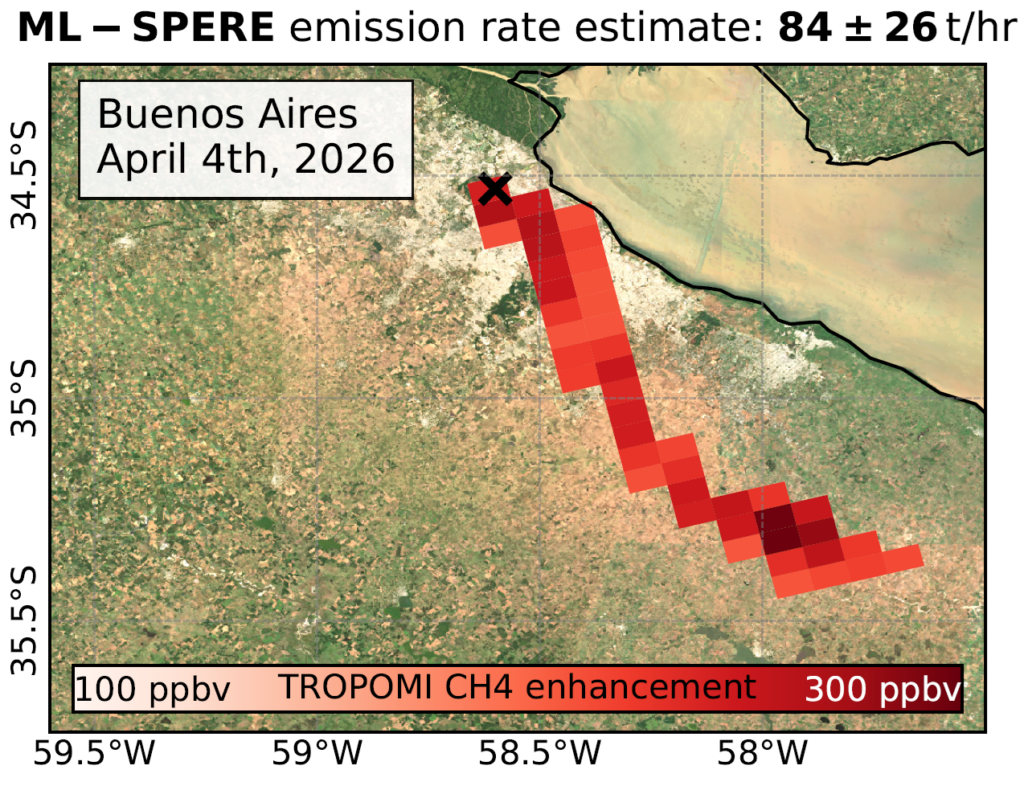
For a few years, SRON has been reporting tens of large methane leaks worldwide on a weekly basis. Its methane research team has developed a machine-learning method to automatically filter out plumes from the millions of pixels it receives back from the TROPOMI space instrument every day. Quantifying the rate at which a plume is leaking the potent greenhouse gas into the atmosphere, is then still a daunting task.

Conventional method
TROPOMI measures methane concentrations in the atmosphere with a large field of view, and can easily spot large super-emitting methane plumes. To estimate plume emission rates, scientists have used the so-called IME method, which derives emission rates from methane concentrations, wind speeds and plume geometry. However, these estimates can be hindered by complicated wind fields and cloud cover that obstruct TROPOMI’s view.
Machine-learning
Now SRON’s methane team, with first author Clayton Roberts, publishes a new machine-learning method that automatically quantifies the emission rates of plumes after SRON’s existing machine-learning system has detected them. They trained their so-called ML-SPERE model with modeled plumes, enabling it to learn the relationships between observed plumes, wind speeds and emission rates. In tests with a set of simulated observations, ML-SPERE outperforms the IME method by reducing the average error from 42.4% to 24.3% for well-observed methane plumes.
Combined strength
ML-SPERE shows consistent estimates with IME on the global scale, confirming the reliability of both methods. Going forward, SRON can quantify plume emission rates using both methods in order to provide two independent emission rate estimates per detection. ML-SPERE gives higher emission rates than IME in regions where TROPOMI detects many low-wind-speed plumes, such as southeastern Australia. ‘It has the ability to better estimate emission rates at low wind speeds,’ says Roberts. ‘We have more detections when the wind speed is low, so it’s important that our new method performs better in this scenario.’
Publication
Clayton Roberts, Joannes D. Maasakkers, Tobias A. de Jong, Berend J. Schuit, Shubham Sharma, Theo Huegens, Anne-Wil van den Berg, Sander Houweling, and Ilse Aben, ‘Machine learning-based emission rate estimates of global methane super-emissions’, Atmospheric Measurement Techniques