



SRON has built an array of 1,504 transition-edge sensors (TES) to provide a backup detector for NewAthena’s X-IFU instrument. It also lays the groundwork for the detection technology of the next-generation of European X-ray telescopes. X-IFU is the imaging spectrometer onboard ESA’s next flagship X-ray observatory NewAthena, to be launched around 2037.
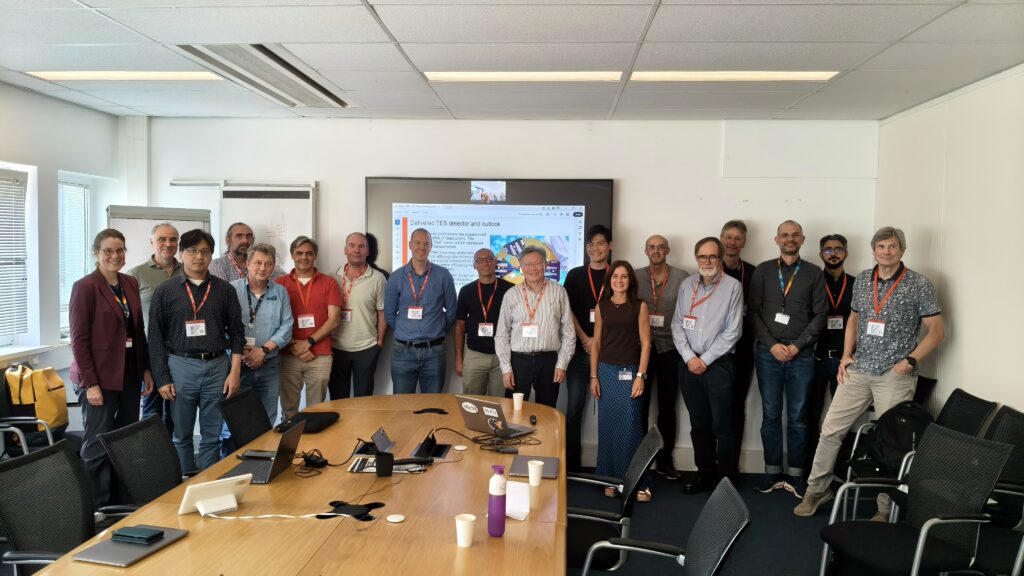
In 2020, SRON started an ESA project to develop an array of transition-edge sensors (TES). In general, the aim was to develop the next-generation of X-ray detector arrays, and in particular to establish a backup for the X-IFU instrument onboard the NewAthena space telescope. Now by successfully completing the project, SRON has shown it is capable of delivering arrays for X-IFU in case the back-up plan comes into effect.

X-IFU works with a different readout system than the one SRON-researchers had spent the twenty years before 2020 developing their TES technology for. They transitioned from a Frequency Domain Multiplexing (FDM) readout to Time Domain Multiplexing (TDM), which comes with several, challenges, such as design, fabrication, and particularly testing. SRON was also advised to increase the overall pixel size before manufacturing the full-size array.
The SRON researchers, led by Jian-Rong Gao, have overcome these challenges and built a full-size array, including wiring routed to bonding pads at the edges of a wafer designed to be compatible with X-IFU’s focal-plane.