



NASA has selected the far-infrared space telescope PRIMA as its Probe mission. It will be the first space telescope with an actively cooled mirror, at 4.5 degrees Kelvin. This reduces noise to such an extent that PRIMA is one thousand to one hundred thousand times more sensitive than its predecessors. SRON, TU Delft, and the University of Groningen plan to deliver the detectors, housing, and insulation of the PRIMAger instrument.
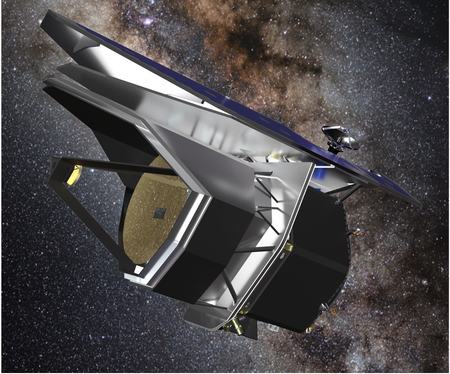
The PRobe far-Infrared Mission for Astrophysics (PRIMA) is scheduled to launch in 2033 to Lagrange point L2. PRIMA is ideally suited to observe the first galaxies. These are surrounded by dust that infrared light can uniquely illuminate. Due to the expansion of the Universe, this light reaches us as far-infrared radiation.

Uncharted Territory
Astronomers seek to unravel how galaxies and supermassive black holes influence each other, to determine the chemical composition of dust and metals in interstellar clouds, and, closer to home, to understand how planets and their atmospheres form. PRIMA also opens up unanticipated discoveries, because far-infrared is one of astronomy’s blind spots. It contains precisely the wavelength of most thermal radiation, emitted by warm objects near and far. So an uncooled mirror easily blinds its own camera. Combining PRIMA’s unprecedented actively cooled mirror with the Dutch detector technology unlocks access to far-infrared sources thousands of times fainter than those we can currently observe.
Thousands of times more sensitive
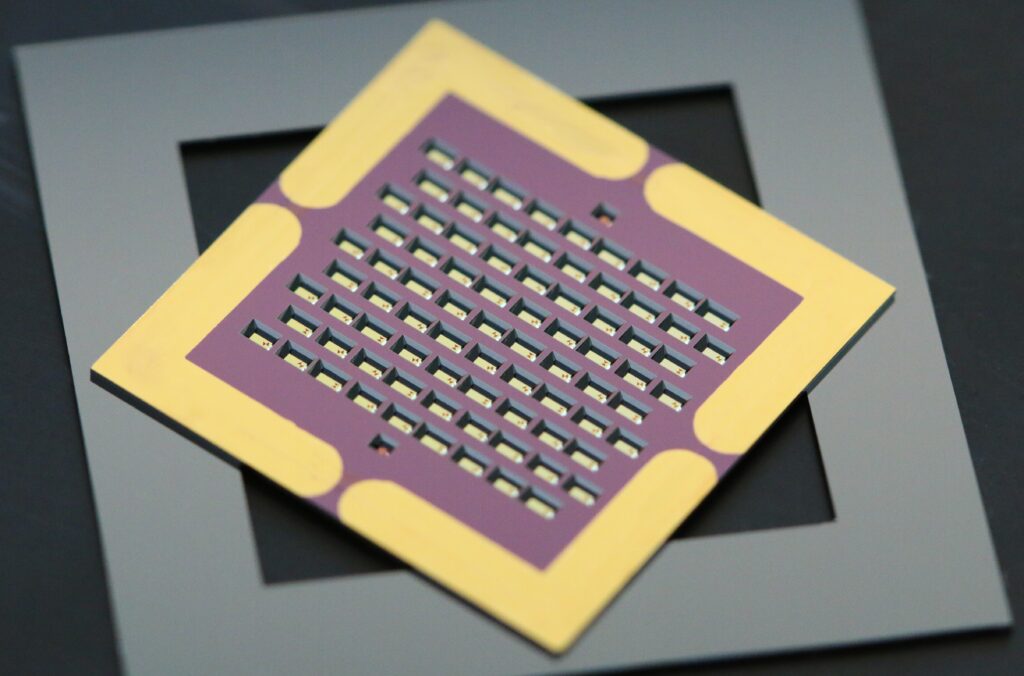
SRON and TU Delft are the prime candidate to develop the inner, most innovative part of PRIMAger: the detection systems, associated housing, and thermal insulation. This is based on in-house Kinetic Inductance Detectors (KIDs), which are so sensitive that they can even measure the background radiation of the Universe. PRIMA requires one-thousandth to one-hundred-thousandth of the time needed by similar telescopes to make an observation. Or, conversely, PRIMA can image objects that are thousands of times fainter, such as the earliest galaxies.
Dutch rainbow filter
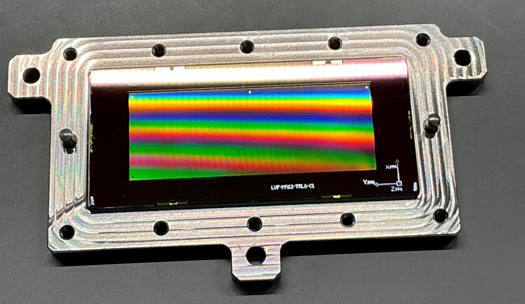
PRIMAger has two detection systems: a polarization camera and a so-called hyperspectral imager, which measures radiation in a narrow wavelength range. SRON and the University of Groningen (RUG) plan to supply a novel color filter to create a rainbow for this purpose. This Linear Variable Filter (LVF) allows different shades of far-infrared light to pass through at each detector location. In this way, it replaces a prism or grating while occupying less volume and weight. Drawing on 15 years of experience and developed technology from an earlier mission concept, SRON and the RUG are also contributing to the system design, integration, and testing of PRIMAger’s flight hardware.