| HIFI Science |
|
|
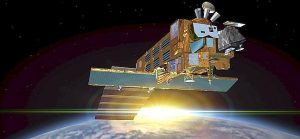
HIFI is the heterodyne instrument for ESA's Herschel satellite. In these pages an overview is given of the possible areas of research with HIFI. Please click on "Science Topics" in the left menu for more specific information. Links for further reading are given in the "HIFI Links" menu item. Official documents about HIFI itself, its interfaces and work organization can be found in the "HIFI Instrument" menu item. The science content has been collected by the Key Program leaders and by the HIFI Project Scientist Prof. Dr. A.G.G.M Tielens. HIFI Guaranteed Time Key Programs: The HIFI consortium has created 7 Key Programs, encompassing the most important science possible with the HIFI instrument. These programs are: A description of the programs can be found by clicking the names. A more general description of HIFI's science capabilities follows below. Science with HIFI: HIFI's superb spectral resolution coupled with its ability to observe thousands of molecular, atomic and ionic lines at submillimeter wavelengths make it the instrument of choice to address many of the key questions in modern astrophysics related to the cyclic interaction of stars and the interstellar medium:
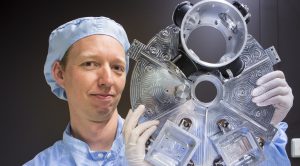
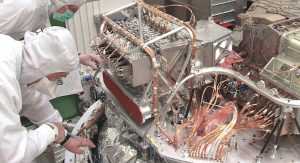
For more information a paper on the scientific capabilities of HIFI by Prof. Dr. Ewine van Dishoeck is available Atmospheric transmissionThe main reason to build HIFI is because the above sketched science cannot be done from the ground, since atmospheric water lines block all radiation coming from space. On the right plots are given the atmospheric transmission (from: Pardo, J.R, Serabyn, E., and Cernicharo, J. 2000)The HIFI InstrumentHIFI is optimised to address the astronomical key questions given above. All of these require high spectral resolving powers and sensitivity. Combining the high spectral resolving power of the radio heterodyne technique with quantum noise limited detection from superconductor physics and with state-of-the-art microwave technology, makes it possible to develop an instrument with a continuous frequency coverage from 480 to 1250 GHz in five bands, while a sixth band will provide coverage for 1410-1910 GHz.at an unrivalled spectral resolution and ultimate sensitivity. This instrument will be able to perform rapid and complecte spectral line surveys with resolving powers from 103 up to 107 (300 - 0.03 km/s) and deep line observations.
|
|||||||||||||||||||||||||||||||