



Sommige objecten en verschijnselen in het heelal kun je alleen vanuit de ruimte goed bestuderen. Bijvoorbeeld omdat ze vooral straling uitzenden die de aardatmosfeer tegenhoudt, zoals röntgenstraling of infraroodlicht. Ook zwakke lichtbronnen zoals exoplaneten kun je het beste bekijken met ruimtetelescopen. Boven de dampkring spelen bijvoorbeeld lichtvervuiling en luchttrillingen geen rol.
Astrofysica
-
Cool universe

-
Hoge energie
-
Exoplaneten
-
Data analyse software

-
ARCiS
-
RADEX
-
SPEX
-
Publicaties
-
For astronomers
Data analyse software
Om de beste wetenschappelijke resultaten uit de meetgegevens van onze instrumenten te halen, ontwikkelen we onze eigen software. Met die programma’s kunnen we berekenen welk spectrum we voor een object verwachten te zien en die vergelijken met de echte meting. Deze software maken we beschikbaar voor iedereen.

ARCiS
ARCiS is een nieuwe code voor de analyse van transmissie- en emissiespectra van exoplaneten. Het doel van het modelleerraamwerk is om een hulpmiddel te bieden waarmee waarnemingen kunnen worden gekoppeld aan fysische modellen van exoplaneetatmosferen. De software wordt voortdurend verbeterd en is gebruikt tijdens de analyse van geavanceerde gegevens van huidige faciliteiten zoals HST en JWST. De software zal ook worden gebruikt voor het aanpassen van de gegevens van de komende ESA Ariel-missie.
Downloaden en installeren
De eenvoudigste manier om ARCiS te downloaden en te installeren is via GitHub
Hulp en documentatie
De gebruikershandleiding is beschikbaar op deze link
Meer informatie, waaronder het downloaden van gegevens, vindt u hier.
RADEX
RADEX is een softwarepakket voor het berekenen van de sterkte van moleculaire en atomaire lijnen van homogene gaswolken in de infrarood- en microgolfband. De gebruiker kan een bepaald molecuul selecteren en de temperatuur, dichtheid, kolomdichtheid en lijnbreedte instellen. Op basis van deze parameters berekent het programma vervolgens de positie en sterkte van de emissielijnen. Het programma kan worden uitgevoerd via een webinterface of offline op een Linux- of Mac-computer.
Downloaden en installeren
De software, geschreven in Fortran, kan worden gedownload.
De website bevat ook installatie-instructies, ervan uitgaande dat je een Fortran compiler geïnstalleerd hebt.
Informatie en hulp
De RADEX website bevat ook informatie over het uitvoeren van het programma. Meer informatie over de berekeningen is te vinden op Zenodo.
Vragen of bugrapporten kunnen als een issue worden ingediend bij onze Github issue tracker
De broncode van RADEX is beschikbaar op Github en Zenodo under an Apache 2.0 license. onder een Apache 2.0 licentie. Iedereen is vrij om het programma te gebruiken. We vragen auteurs die gebruik maken van het RADEX-programma wel om ons artikel te citeren: Van der Tak, F.F.S., et al. 2007 .
SPEX
SPEX is een softwarepakket voor röntgenspectraalanalyse dat geoptimaliseerd is voor de interpretatie van astrofysische röntgenspectra met hoge resolutie. De software is vooral geschikt voor het ‘fitten’ van spectra verkregen door huidige röntgenobservatoria zoals XMM-Newton, Chandra, Suzaku en XRISM. SPEX zal voortdurend worden verbeterd om spectra van hoge-resolutie röntgeninstrumenten op toekomstige missies zoals NewAthena te kunnen verwerken.
SPEX is open-source software en wordt gedistribueerd onder een GPLv3 licentie. De broncode is beschikbaar op Zenodo.
Downloaden en installeren
SPEX is ontwikkeld voor Linux- en Mac-systemen, maar kan ook draaien op het Windows subsysteem voor Linux (WSL) of met behulp van een virtuele machine. Meer informatie over het downloaden en installeren van SPEX vind je via deze link.
Hulp en documentatie
De SPEX documentatie is beschikbaar op Github. Voor vragen en bugrapporten kunnen gebruikers een issue indienen op de Github repository.
Pyspextools
Naast het SPEX-pakket hebben we ook een Python-pakket genaamd pyspextools. Dit bevat gereedschappen om bestanden in OGIP formaat te converteren naar SPEX formaat. Meer informatie over Pyspextools is hier te vinden:
Het pyspextools-pakket wordt verspreid onder de Apache 2.0-licentie.
Aanmelden voor onze nieuwsbrief
XRISM Spectroscopy of Variable Accretion-driven Disk Winds in NGC 4151: When, Where, and How Fast Outflows are Launched
01/10/2026 - Low-Energy
X-ray observations probe the inner accretion flow within active galactic nuclei, revealing the highest gas column densities and fastest winds. The most diverse winds yet revealed with the Resolve calorimeter spectrometer aboard XRISM are found in NGC 4151, a nearby Seyfert 1 active galactic nucleus (AGN) that may qualify as a changing-look source (CLAGN). Herein,…
Lees meer
3D radiative transfer of Lyman-series lines with SKIRT
01/10/2026 - High-Energy
Context. High-resolution X-ray spectroscopy and polarimetry provided by XRISM and IXPE offer new diagnostics of the geometry and kinematics of photoionised plasmas around compact objects. Interpreting reprocessed X-ray emission in such systems requires a full three-dimensional radiative transfer (3D RT) including photon-ion interactions. Aims. We extended the Monte Carlo (MC) RT code SKIRT by implementing…
Lees meer
Can the long-term impact of stellar M-dwarf flares alter the spectral features of a giant gaseous exoplanet?
01/10/2026 - Exoplanets
In this work, we model the long-term impact of recurrent stellar flares on the atmospheres of metal-rich gaseous exoplanets. Using synthetic flare spectra from a fiducial flare model integrated with a photochemical kinetics code, we track the changes in atmospheric composition with time. We further analyze the spectral variability by feeding these abundance profiles into…
Lees meer
Exoplanet programme: Vision
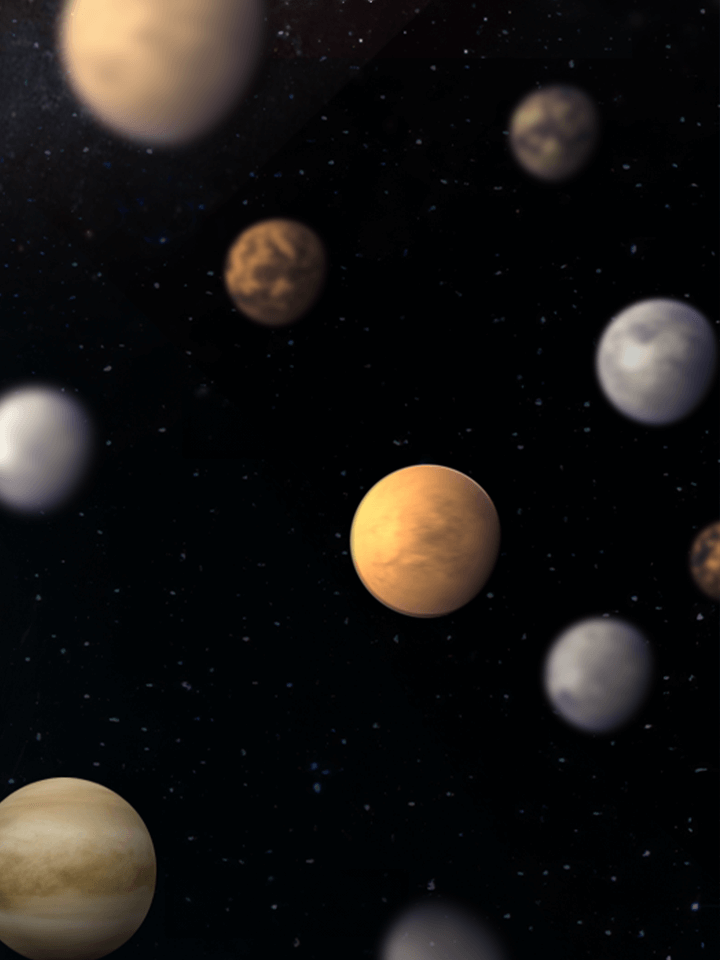
SRON’s Exoplanet team tackles the fundamental question of where the Solar System and the Earth fit within the diversity and evolution of planetary systems throughout the Universe. This question is fundamental to humankind and aligns with key scientific questions formulated by international scientific organisations such as ESA and NASA.
We address this fundamental question by studying the atmosphere, internal structure and formation of planets and their moons inside and outside the Solar System.
Addressing these questions requires a stability and wavelength coverage only achievable from space. Apart from air vibrations and blocking certain wavelengths, the Earth’s atmosphere also pollutes the data we can from a planet’s atmosphere.
Place in the community
We perform fundamental science, while serving as a hub connecting space missions, technology development, and the Dutch scientific community. This enables collaborations that are essential to realising our scientific vision. We ensure visibility, participation, and scientific roles for the Dutch community in exoplanet space missions.
We aim to be a group where researchers can grow scientifically and professionally, working in an open, collaborative, and inclusive environment at the interface of science, technology, and space missions.
High-energy programme: vision
The High-Energy group addresses two themes. What are the fundamental physical laws of the Universe? And how did the Universe originate and evolve and what is it made of?
This translates into studying the principles governing the cosmos, based on two pillars:
-Feedback: how the universe is enriched with metals and energy from our Galaxy to supermassive black holes and the cosmic web.
-Compact objects and their environment: how physics works in strong gravity and how objects accrete matter
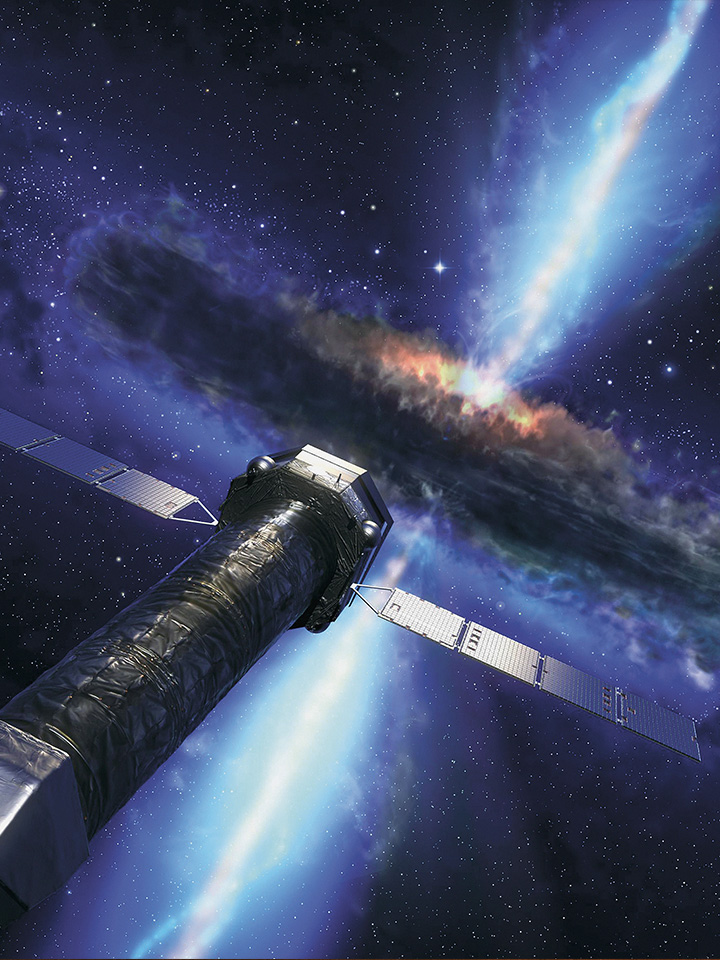
High-energy astrophysics offers a privileged vantage point, as the most energetic phenomena emit radiation in the X-ray band and at the same time gravitational waves provide an extra independent messenger. This gives us direct access to otherwise invisible compact objects in binary systems and enables a multimessenger view of high-energy phenomena. These can only be studied from space. This scientific vision is an integral part of the SRON science mission life cycle: moving from science to innovative technology and instrumentation. These broad themes encompass not only present scientific interests but also future, unexplored frontiers.
Place in the community
The high-energy group occupies a leading position in the local and international scientific community by combining deep knowledge about our instruments, the radiation mechanisms in the sources we observe, data analysis methods and applied models. We strive to be a hub for innovation. While maintaining our core expertise in high-energy astrophysics, we are committed to defining the frontier, actively shaping new research directions.
Cool Universe programme: vision
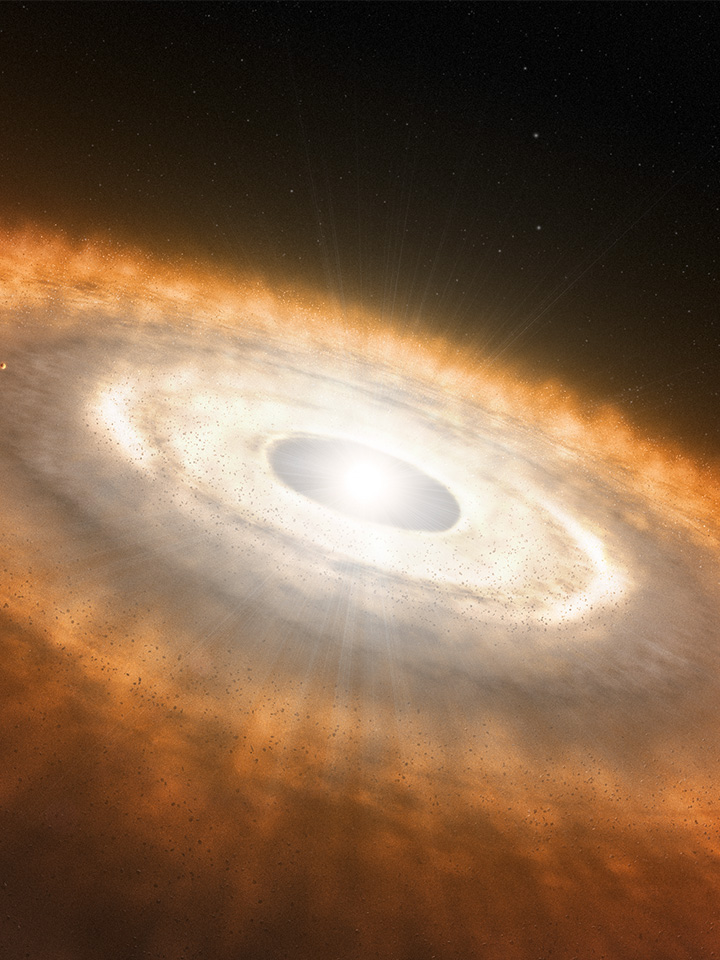
SRON’s Cool Universe team works on unravelling the cold, the dusty, and the distant universe. Mid- and far infrared radiation (IR), observable only from space, penetrates any foreground dust and allows direct measurements of local physical conditions in cool objects. The IR is uniquely rich in spectroscopic diagnostics, and the cosmic background in the IR is as rich as the optical in terms of energy density and therefore also in terms of information on the structure of the universe.
These diagnostic tools enable research into a large range of subjects, from understanding our own solar system to the formation history and evolution of planet forming systems, to galaxy formation and evolution over cosmic timescales.
Jointly with the national and international astronomy community we identify opportunities to further develop research tools targeting these domains, both in instrumentation and modelling. We seek possibilities for collaborations with mission consortia pursuing such developments.
A large variety of astrophysics research domains are accessible in the IR domain, and further progress in these fields critically depends on that access. The Astro Cool Universe team currently focuses on galaxy evolution and star- and planet forming systems, but clearly the field also links to e.g. exoplanet research – all directly aligning with the priorities identified in e.g. Voyage 2050, Astro2020 and Astronet.
Place in the community
The backbone knowledge of SRON’s Cool Universe team will be expanded towards new directions of research and instrumentation development leading to targeted new mission and research proposals. We connect with other research institutes to foster collaborations towards such joint projects.
Onze experts
-
 Lees meer
Terri Brandt
Head of Astrophysics Programme (Dr.)