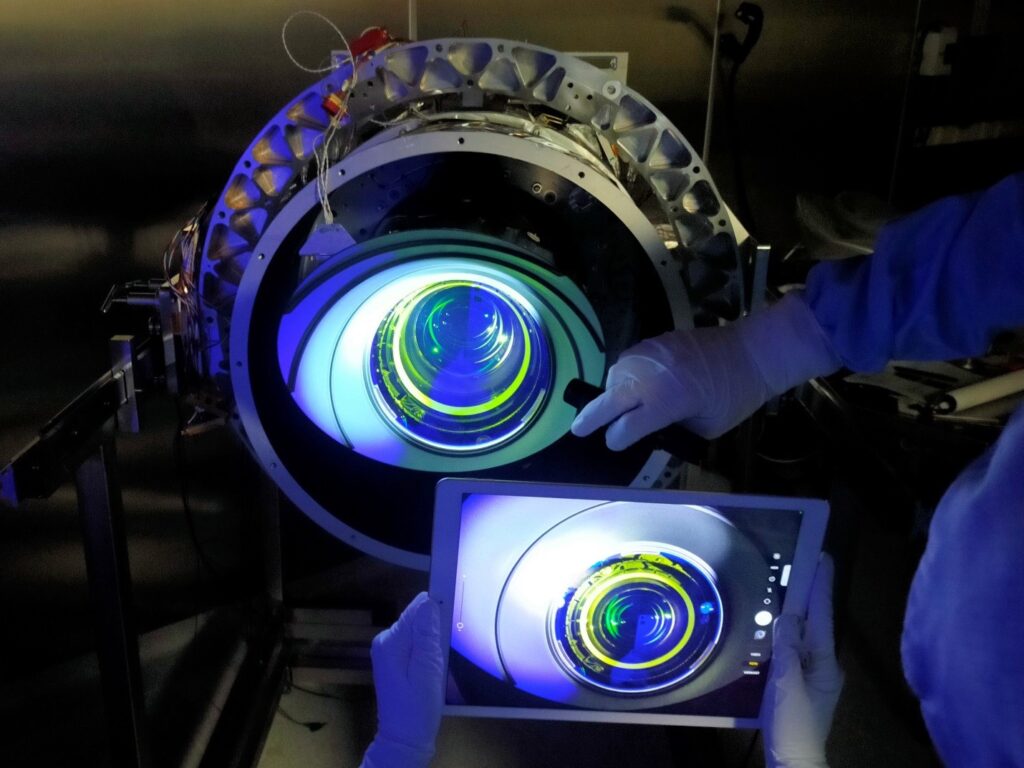



An international team of astronomers, led by Yamila Miguel (SRON/Leiden Observatory), has found that Jupiter’s gaseous envelope doesn’t have a homogeneous distribution. The inner part has more metals than the outer parts, adding up to a total of between 11 and 30 earth masses, meaning 3-9% of Jupiter’s total mass. This is a high enough metallicity to conclude that kilometer-sized bodies—planetesimals—must have played a role in Jupiter’s formation. Publication on June 8th in Astronomy & Astrophysics.
Month: May 2022
First tests exoplanet hunter Plato in space conditions
Together with its partners, ESA is working on a new exoplanet hunter mission called Plato, to be launched in 2026. Astronomers expect to discover Earth-sized planets within the habitable zone because of Plato’s ability to spot smaller planets in larger orbits than current telescopes. SRON Netherlands Institute of Space Research contributes to the project by testing Plato’s cameras in a custom built space simulator. SRON researchers have finished testing the prototype—all features function as expected. The framework for the cameras is now undergoing a month-long vacuum soak at ESA to evaluate its endurance under space conditions.