



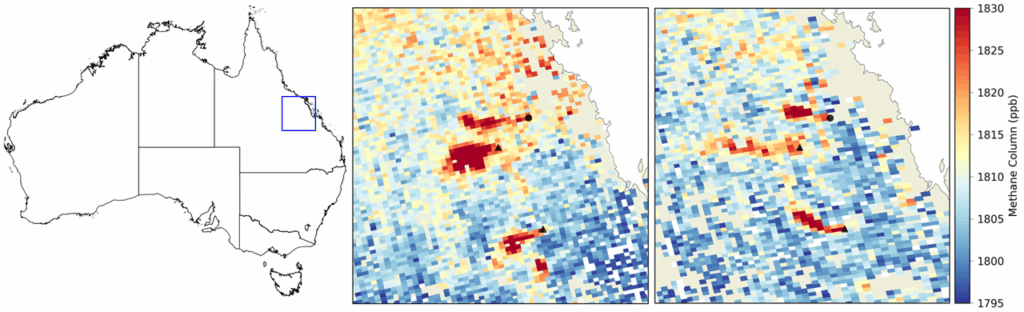
A Dutch group of scientists has used space instrument TROPOMI to calculate methane emissions from six Australian coal mines. Together these account for 7% of the national coal production, but turn out to emit around 55% of what Australia reports for their total coal mining methane emissions.
Month: November 2021
MKID detectors turn out to have 100 times lower noise
Scientists develop superconducting detectors (MKIDs) to discern the spectrum of exoplanets from their faint glow. Now researchers from SRON and TU Delft see a hundred times lower noise than previously thought. It provides a new fundamental physics insight: the relationship between the number of quasi particles and their lifetime vanishes. Publication in Physical Review B.

Bolometers operate at higher temperatures using new superconducting material
Receivers combining a superconducting hot electron bolometer (HEB) with a reference oscillator are the work horses of supra-terahertz astronomy, observing for example star formation and galaxy evolution. Until now, mainly niobium nitride HEBs – that have to be operated at low temperatures of 4 Kelvin – have been selected for space and balloon borne telescopes. A team of scientists at SRON, TU Delft, Chalmers University and RUG have now demonstrated a HEB based on magnesium diboride, a new superconducting material, which not only can simultaneously detect more spectral lines, but can also be operated around 20 Kelvin. The latter can significantly reduce the cost, weight, volume, and required electrical power of space instruments. Publication in Applied Physics Letters.
Simultaneous readout of 60 bolometers for far-infrared space telescopes
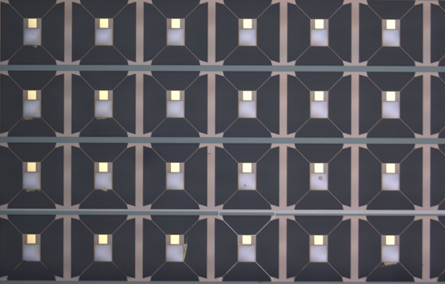
TES bolometers with simultaneous readout of multiple pixels are the candidate detector technology for a number of space missions for sub-millimeter and far-infrared wavelengths, such as LiteBIRD and OST. Qian Wang, a PhD student at SRON and RUG, has demonstrated a simultaneous readout of 60 TES bolometers. Publication in Applied Physics Letters.
Simultaneous TES readout at level of Athena-like telescopes
SRON scientists have managed to simultaneously read out the signal of 37 TES pixels at a resolution of 2.2 eV for X-rays (6 keV). It is the first time that a simultaneous readout fulfills the requirements for future space telescopes at the level of Athena in terms of both number of pixels and energy resolution. In 2020, SRON already set a world record of 1.3 eV energy resolution for X-rays with TES, but only with a single pixel readout.