


With SCIAMACHY, scientists were able to create global maps of ozone and gases important to ozone formation and depletion, such as nitrogen dioxide (NO₂) emitted by traffic and industry, as well as bromine and chlorine compounds. The maps had a pixel resolution of 60 by 30 km. Additionally, the instrument mapped the distribution of gases such as carbon monoxide and methane.
Other instruments on EnviSat observed phenomena such as crumbling ice caps and the breathing of the oceans. Shortly after its launch in 2002, Envisat used its radar instruments to record the collapse of the Larsen B ice shelf in Antarctica. In the following years, the mission tracked how glaciers retreated, how the sea ice around the North Pole thinned, and how massive icebergs calved and drifted away. The MERIS spectrometer measured global sea-level rise to an accuracy of two centimeters, yielding millimeter precision after years of averaging. Furthermore, it recorded temperature fluctuations in seawater, which aided in forecasting weather phenomena like El Niño.

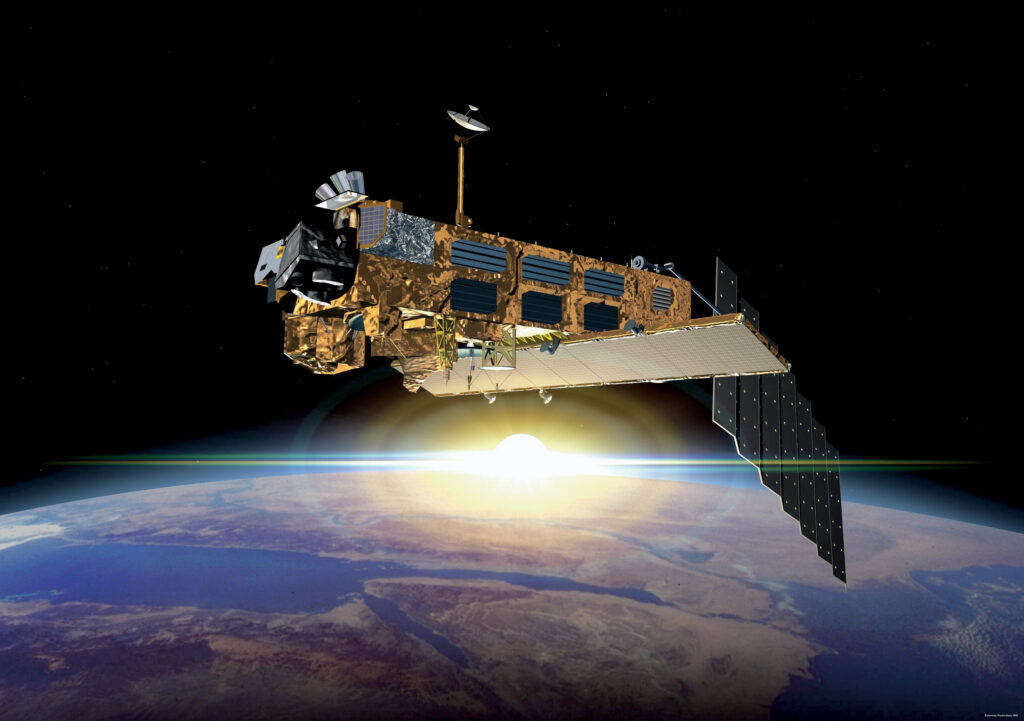
Weighing eight tonnes and about the size of a tour bus, EnviSat was the largest Earth observation satellite ever built. On board was a suite of ten instruments, ranging from radar instruments for monitoring ice shelves to spectrometers for analyzing the oceans and the atmosphere.
SRON’s Contribution
SRON contributed to the SCIAMACHY instrument, a joint project between The Netherlands, Germany and Belgium. SCIAMACHY observed the sunlight reflected back into space by the Earth’s surface and atmosphere. Because each atmospheric gas absorbs specific wavelengths of sunlight, it leaves a barcode in the spectrum. This allows scientists to create global maps of the atmospheric concentrations of various gases. SCIAMACHY, and the GOME instrument derived from it, were the first instruments to observe human emissions across a complete spectrum, and as such, they pioneered all subsequent missions with similar objectives.
SRON was the Dutch co-Principal Investigator for SCIAMACHY. SRON developed the eight detector modules and was involved in the calibration and data processing of the infrared channels. Moreover, SRON contributed to the scientific utilization of the data. For example, SRON scientists discovered that carbon monoxide from the Amazon region can lead to air pollution on the other side of the world, in Australia.