



Software developed at SRON in the 1990s for explanatory calculations in space research has proved to be of enduring value to the wider scientific community. The method, based on the mathematical work of the 18th-century mathematician Thomas Bayes, is now also an essential component of the software for the James Webb Space Telescope (JWST).
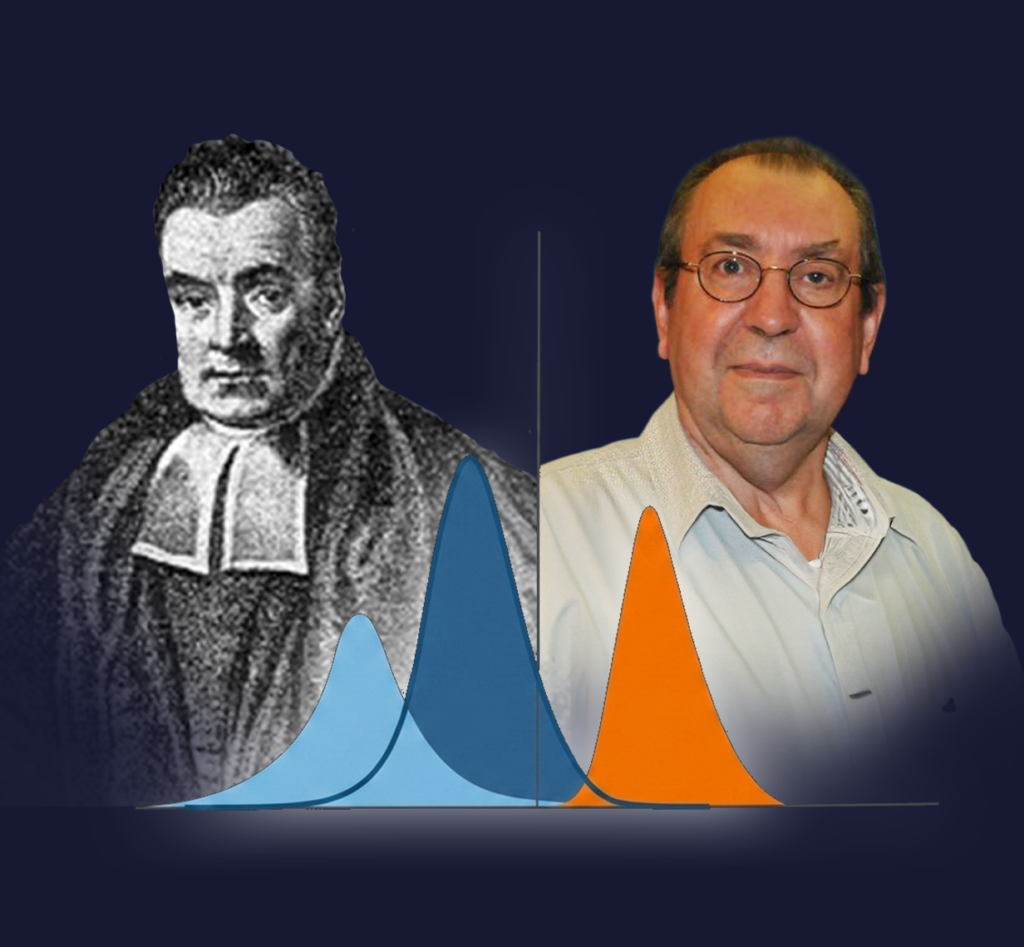
Download milestone
Retired former colleague Do Kester from SRON has surpassed the impressive milestone of one million downloads with his BayesicFitting software package.

What is BayesicFitting?
Kester’s software is a practical tool for data modelling. BayesicFitting calculates which model best fits the data. But the software also helps improve simulation by calculating which of several explanatory models is the most likely.
BayesicFitting can be extremely valuable in other scientific disciplines and for machine learning. It offers more than 100 ready-to-use classes for models and ‘fitters’, which significantly lowers the barrier to complex Bayesian calculations.
Software pioneering
BayesicFitting began as a tool for analysing data from the SRON-led Dutch HIFI far-infrared instrument on the Herschel satellite (2009).
It was written in the 1990s in Java, at the time a brand-new language that worked with classes and functioned identically on every computer platform.
Preserving a useful Bayesian tool
When support for the mission software ceased, Kester converted it to Python, after which it has since been downloaded more than a million times.
BayesicFitting is now an ‘affiliated package’ of Astropy, a standard package used by many astronomers.