



 Back to the story of SRON
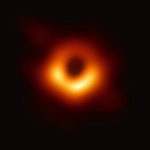



First black hole image
2019
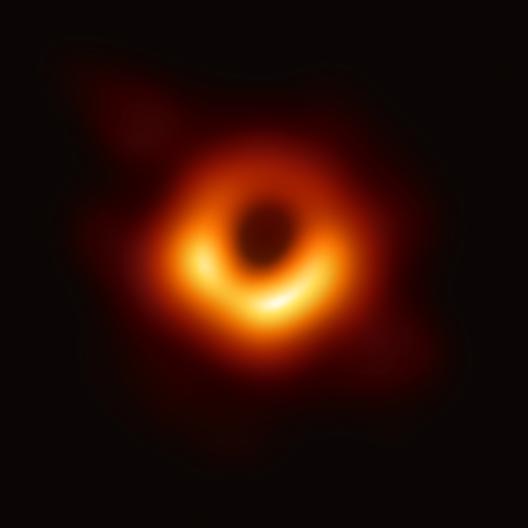
Black holes are the most massive objects in the universe, but they are so densely compressed that they have no dimensions. An imaginary shell surrounds this point-like hole in space-time. Anything inside it can never escape and will inevitably plunge into the black hole. The supermassive black hole in the galaxy M87 is billions of times more massive than our Sun, with a shell that is nearly thirty thousand times wider. But because M87 is 55 million light-years away, this translates to a paltry 42 millionths of an arcsecond in the sky. Think of it as an orange or a doughnut on the Moon.
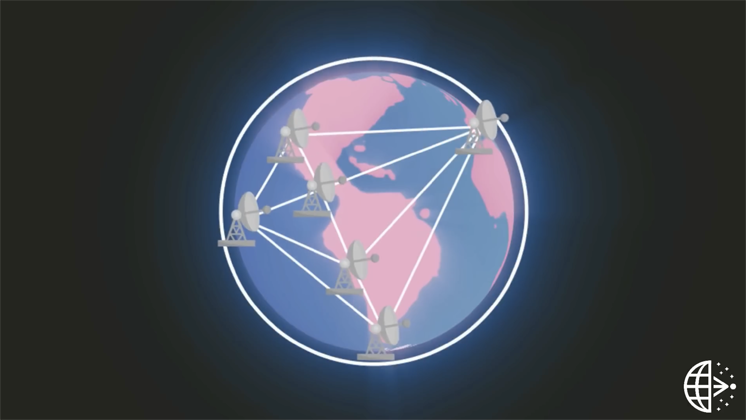
It is impossible to capture it on camera with a single telescope. That is why, in the 2010s, astronomers decided to link up radio telescopes across the globe to achieve a resolution equivalent to a dish the size of the Earth. Using this Event Horizon Telescope, they succeeded for the first time in taking a photograph of a black hole. On 10 April 2019, the world gazed in awe at an image of an orange-coloured doughnut, known to astronomers as M87*.
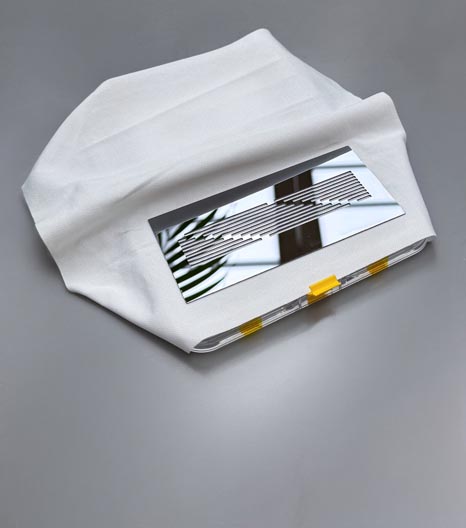
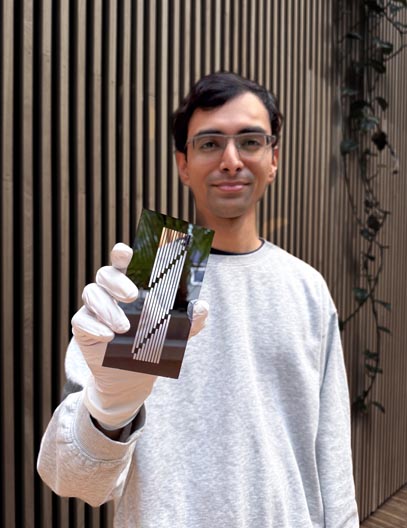
Scientists refer to the combining of telescopes as interferometry. The Event Horizon Telescope uses radio waves, which, due to their long wavelength, are the easiest to combine. X-rays are more difficult to capture with an interferometer, but do provide a higher resolution. It also reveals other parts of a black hole, such as the dust disc, which becomes so hot due to the high speeds and friction that it emits X-rays. That is why SRON is working on a technology that will enable a future X-ray interferometer to image black holes from space with unprecedented resolution.
- The first image of a supermassive black hole, as captured by the Event Horizon Telescope (video); Combined telescopes form the telescope as large as the Earth, using interferometry; SRON hardware for future space-based interferometry for X-rays, which can not be measured under the atmosphere.