

Skip to content

To bring about breakthroughs in international space research

  • Home
  • Research Questions
  • Pillars
  • Missions
  • About Us
  • Contact
Home
  • nl
  • en
Logo of SRON Space Research Organisation Netherlands

SRON | Space Research Organisation Netherlands

SRON space research institute

Logo of SRON Space Research Organisation Netherlands
  • Research Questions
  • Pillars
    • Science
    • Technology
    • Instrumentation
    • Our experts
    • Impact
  • Missions
  • About Us
  • News, Blogs & Events
  • Contact
  • SRON Academy
  • SRON Careers
  • Visit to SRON
Home
  • nl
  • en
  • Research Questions
    • How do we unravel the physics behind black holes?
    • How can we image the faintest exoplanets?
    • Where are greenhouse gases emitted?
    • How special is earth in context of the universe?
    • How do black holes form and grow?
    • How do aerosols affect the climate?
    • How do stars and planets form?
    • How is climate change affecting life on Earth?
  • Pillars
    • Science
      • Astrophysics
        • Cool universe
        • High Energy
        • Exoplanets
      • Earth
        • Methane
        • Aerosols and Clouds
        • CO2
        • Carbon monoxide
    • Technology
    • Instrumentation
      • Nanotechnology
      • Cryogenics
      • Optics
      • Electronics
      • PA/QA Quality
      • Mechanics / Realisation
    • Our experts
    • Impact
  • Missions
    • Active
      • ALMA
      • GUSTO
      • PACE
      • Sentinel-5p
      • SPEX airborne
      • XRISM
    • In development
      • ARIEL
      • LISA
      • Sentinel-5
    • Legacy
      • BeppoSAX
      • STO2
  • About Us
    • Facilities
    • History
  • News, Blogs & Events
  • Contact
  • SRON Academy
  • SRON Careers
  • Visit to SRON
dark blue version of the logo of SRON space research organisation netherlands
  • Privacy policy
Back to the story of SRON
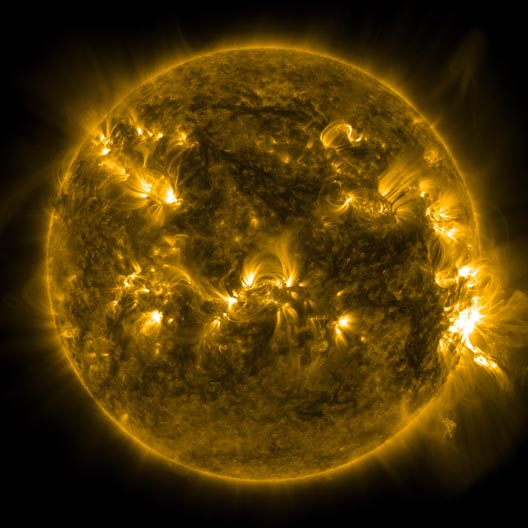
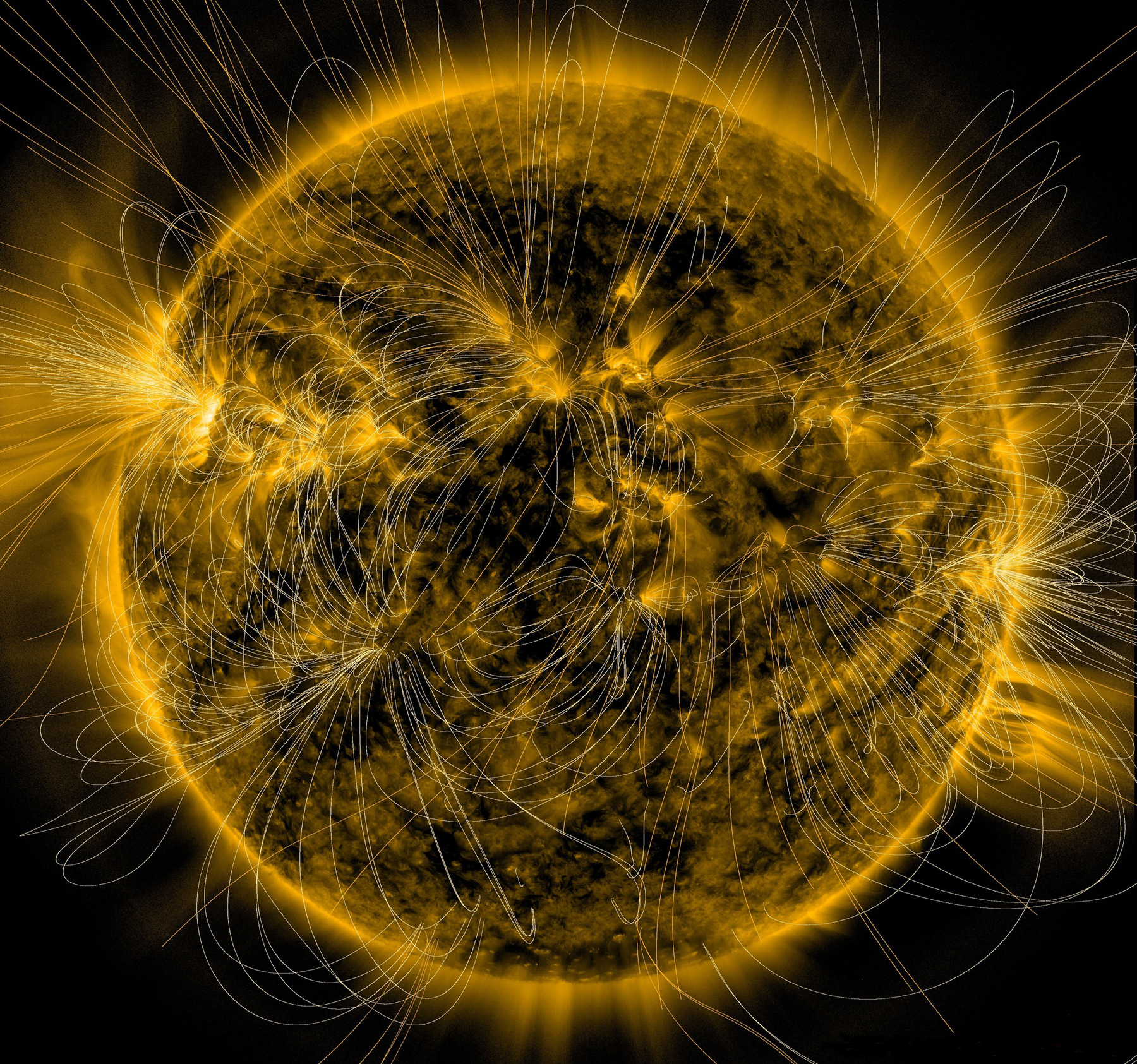
  • Detailed image of the Sun in golden-yellow tones, showing bright solar flares and arching plasma loops that reveal magnetic activity around the solar surface.
  • Visualisation of the Sun with bright, curved lines illustrating the complex magnetic fields and activity around its surface.
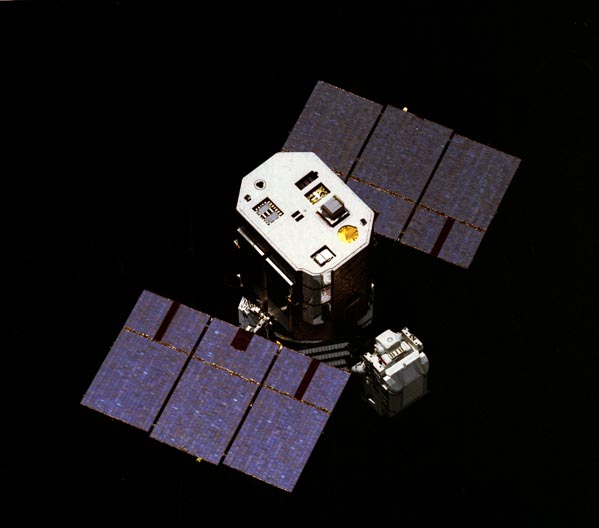
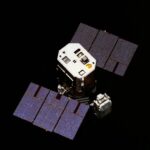
  • Na een baanachtervolging door een Challenger shuttle, probeert een astronaut (rechtsonder) met een robotarm SolarMAX uit de lucht te pakken. Credit: NASA
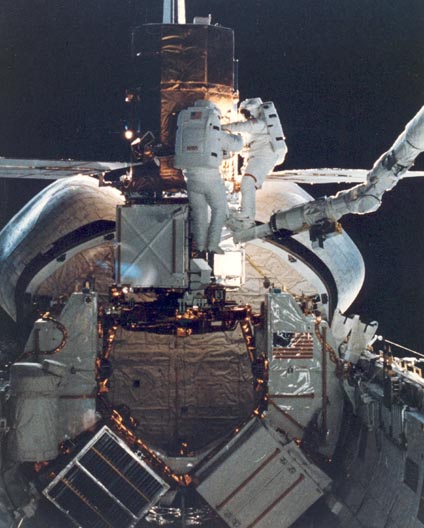
  • De eerste satellietreparatie in de ruimte is een feit. Credit: NASA
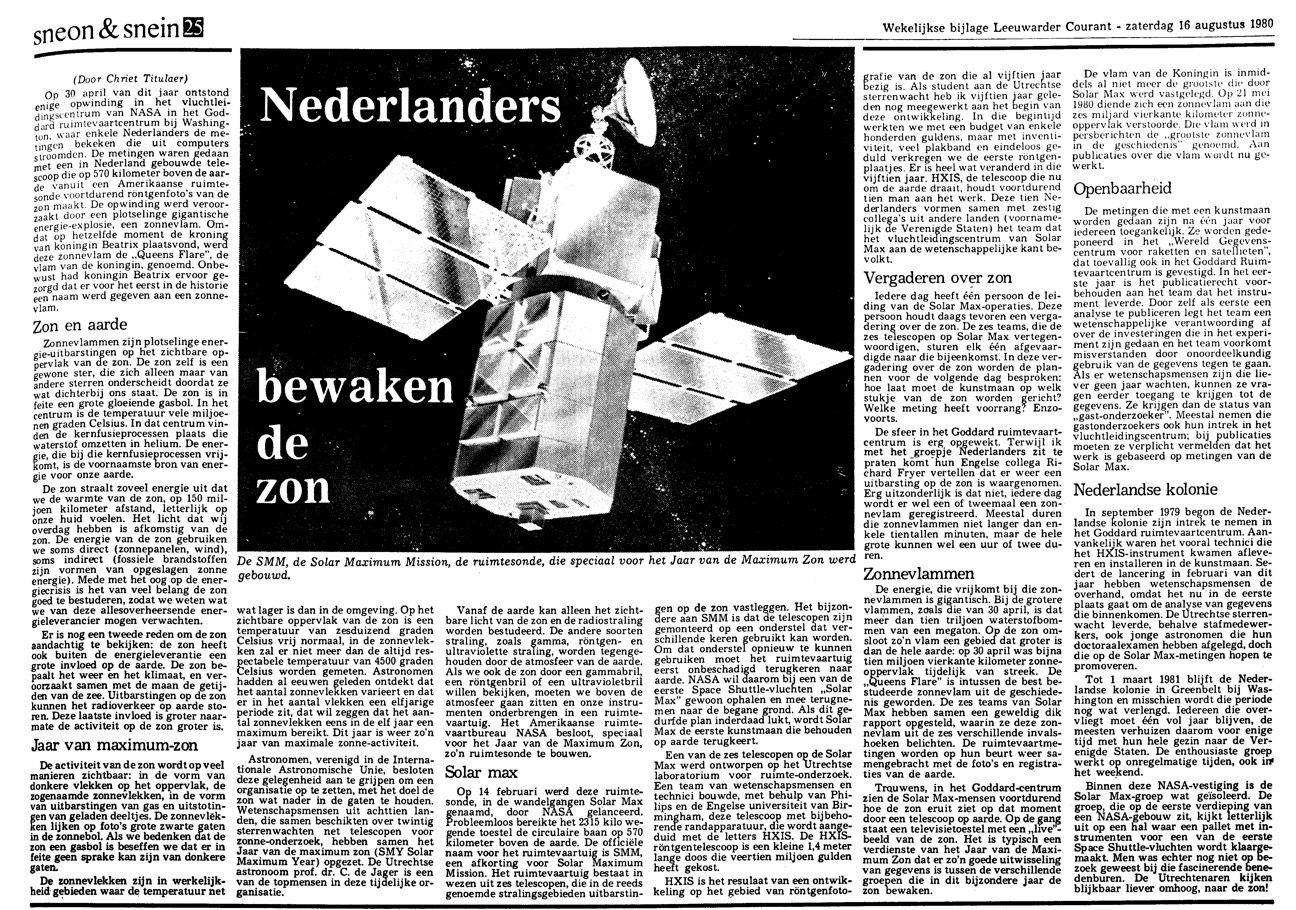
  • Artikel van Chriet Titulaer over de ‘Queens Flare’ en de Nederlandse rol in SolarMAX. Credit: Leeuwarder Courant via Delpher.

Sheer powers of the sun

1980

The 1960s… Using the first X-ray instruments mounted in the nose cones of sounding rockets, space researchers in Utrecht discovered that the Sun has a corona with a temperature of millions of degrees.

Then, in 1972, their experiments on the TD-1A satellite allowed for longer-term observations. And much more stable ones. They discovered that solar flares emit X-rays in short, intense flashes, known as ‘elementary bursts’...

In 1980, as the Sun was once again going through its eleven-year active cycle, a new Utrecht-developed instrument was carried aboard NASA’s Solar Maximum Mission: the X-ray imager HXIS.

This taught us how solar flares arise when magnetic field lines suddenly form loops. HXIS observed the footpoints of these loops glowing brightly on the Sun, acting as point contacts for an electric current of billions of amperes.

The current heats the gas within the loop, triggering the emission of X-rays. The gas can reach temperatures of up to 40 million degrees. One example is the widely studied ‘Queen’s Flare’ on 30 April 1980, the day Queen Beatrix was crowned. As the hot gas expands, the loop rises until it ‘snaps’. And voilà: a solar flare.

Dutch space research owes much of its new knowledge and experience to the world-renowned solar research carried out in Utrecht. However, following SolarMAX, the focus of the space laboratories shifts towards X-ray and infrared astronomy of phenomena outside our solar system. Other missions however, continue to uncover new secrets of the Sun.


  • Photos, credit NASA: A solar flare; Magnetic fields on the Sun; An astronaut (bottom right) attempts to retrieve SolarMAX from the air using a robotic arm; Astronauts carrying out a spacewalk. The first satellite repair in space has been successfully completed.
  • Article about SolarMAX in the Leeuwarder Courant, available to read in the Delpher newspaper archive.
  •  
a modern office building of 4 floors with lights illuminating the ground floor and a small sounding rocket in front of the building

Leiden

Niels Bohrweg 4
2333 CA Leiden
The Netherlands
+31 (0)88 777 56 00

a new and modern 4 floor building in light grey color with people walking in front of it

Groningen

Landleven 12
9747 AD Groningen
The Netherlands
+31 (0)50 363 40 74

  • Research Questions
  • Pillars
    • Science
    • Technology
    • Instrumentation
    • Our experts
    • Impact
  • Missions
  • About Us
  • News, Blogs & Events
  • Contact
  • Newsletter

Niels Bohrweg 4
2333 CA Leiden
The Netherlands
+31 (0)88 777 56 00

Landleven 12
9747 AD Groningen
The Netherlands
+31 (0)50 363 40 74

NWO-I

SRON is part of the Institutes Organisation of NWO

  • Privacy policy
Logo of SRON Space Research Organisation Netherlands

Follow us on social media

SRON on bluesky SRON on Instagram SRON on LinkedIn

What happens up there, starts down here.

Manage consent
To provide the best experiences, we use technologies such as cookies to store and/or access information about your device. By agreeing to these technologies, we may process data such as browsing behavior or unique IDs on this site. If you do not consent or withdraw your consent, this may adversely affect certain features and functionality.
Functional Always active
The technical storage or access is strictly necessary for the legitimate purpose of enabling the use of a specific service expressly requested by the subscriber or user, or for the sole purpose of carrying out the transmission of a communication over an electronic communications network.
Preferencs
The technical storage or access is necessary for the legitimate purpose of storing preferences not requested by the subscriber or user.
Statistics
The technical storage or access used solely for statistical purposes. The technical storage or access that is used solely for anonymous statistical purposes. Without a subpoena, voluntary compliance by your Internet Service Provider, or additional information from a third party, information stored or retrieved solely for this purpose generally cannot be used to identify you.
Marketing
De technische opslag of toegang is nodig om gebruikersprofielen op te stellen voor het verzenden van reclame, of om de gebruiker op een site of over verschillende sites te volgen voor soortgelijke marketingdoeleinden.
  • Manage options
  • Manage services
  • Manage {vendor_count} vendors
  • Read more about these purposes
Check preferences
  • {title}
  • {title}
  • {title}