



 Back to the story of SRON

The Golden Age of X-ray Astronomy
1999
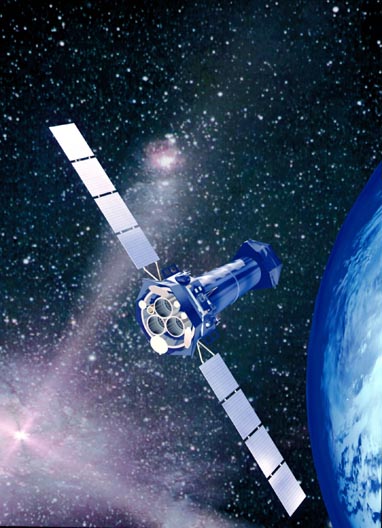
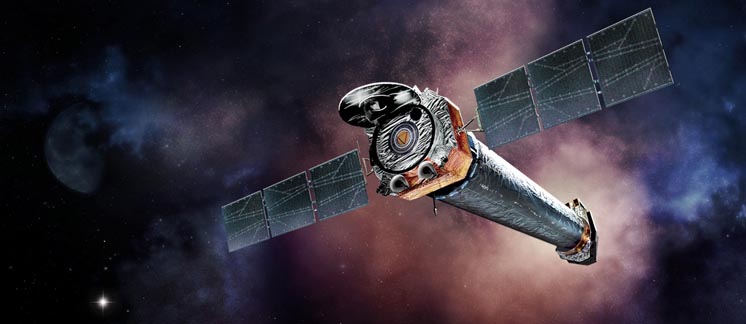
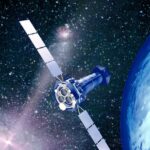
In July and December 1999, two X-ray telescopes were launched which complement each other and have thus opened up the X-ray sky to astronomers. They have continued to do so for decades, well beyond their planned lifespans: NASA’s flagship mission Chandra and ESA’s XMM-Newton.
Chandra has smaller mirrors but is razor-sharp. Thanks to its large mirrors, XMM Newton captures an enormous amount of light in a shorter time, but with slightly lower resolution. Drawing on years of experience in X-ray spectrometry, SRON played a crucial role in developing spectrometers that break down the light for analysis.
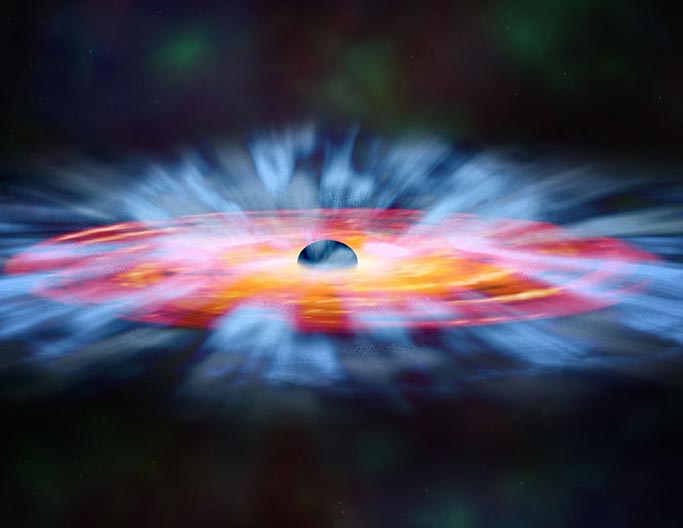
Chandra’s Low Energy Transmission Grating is perfect for analysing compact point sources. XMM Newton’s Reflection Grating Spectrometer excels in the study of more extended objects: enormous gas clouds in clusters of galaxies and tenuous gas filaments of the cosmic web. Together, they reveal the influence of supermassive black holes on their wider surroundings.
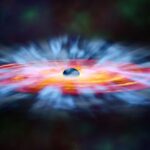
The wavelengths they observe are packed with spectral lines from elements such as carbon, nitrogen, oxygen, neon, silicon and iron. This has enabled astronomers to measure the exact temperature, density and pressure of gas orbiting black holes or being blown far away from supernova explosions. Whilst XMM-Newton quickly maps out the general dynamics, Chandra determines very precisely at what exact distance and at what speed iron and oxygen atoms are flying away or spinning around a black hole.
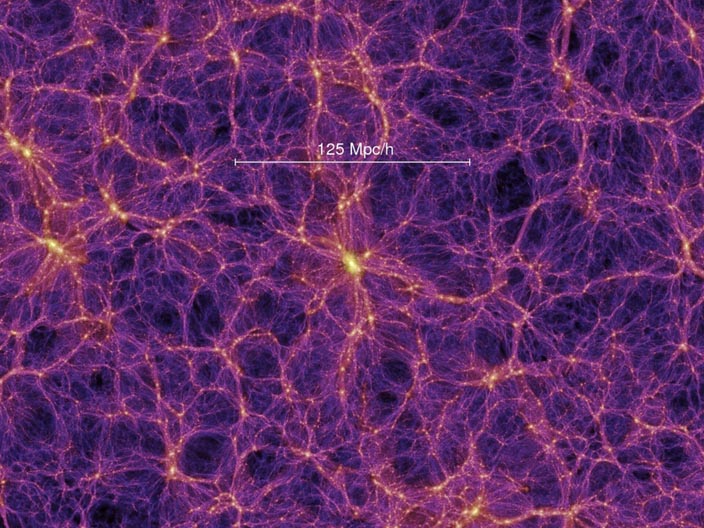
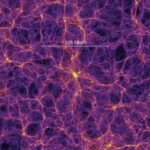
When radiation from distant galaxies encounters filaments of dust on its journey towards us, the rarefied gas in the space between them absorbs very specific wavelengths of this light. This was the ‘smoking gun’ proving the existence of the vast cosmic web, made up of barely visible filaments of matter.
- Foto’s NASA, ESA, ESO: Much of the matter is so tenuous that it lies like a thin thread of cobweb amongst the more intensely radiating matter. Before Chandra and XMM-Newton, we were not really able to measure this properly; dynamics around black holes can now be studied much more effectively; XMM-Newton; Chandra.