



 Back to the story of SRON
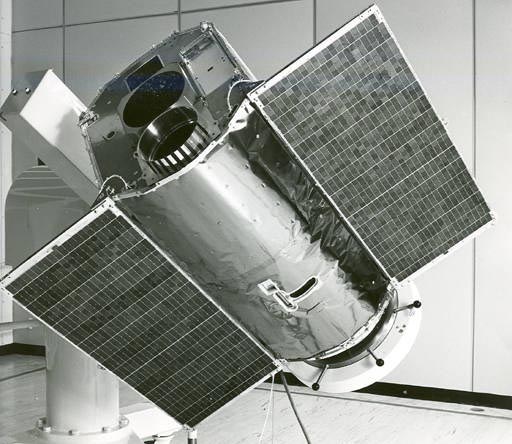
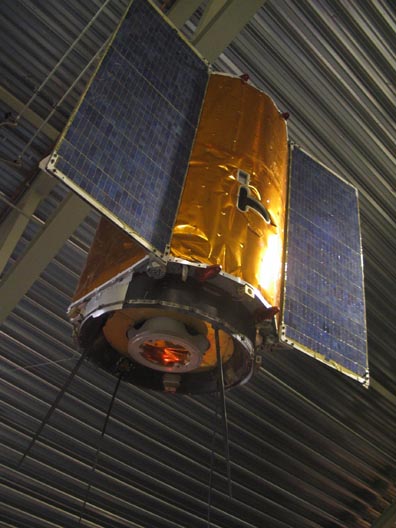

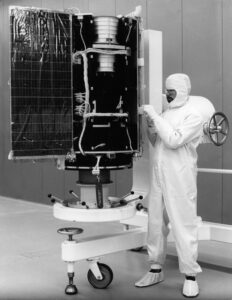
The Astronomical Netherlands Satellite
1974
“5, 4, 3, 2, 1.... We’ve got liftoff...” On 30 August 1974, an American rocket launched the Dutch Astronomical Satellite, carrying two Dutch scientific instruments and one American scientific instrument.
SRONs predecessors and Dutch industry, including Philips and Fokker, had been working closely together since the early pioneering days. With ANS, they put the Netherlands on the world map in international spaceflight.
ANS carried instruments for UV and X-ray radiation and, thanks to a positioning system provided by the industry, could be aimed at its targets with great precision (1 arcminute). Moreover, thanks to the reprogrammable computer supplied by the Dutch industry, the observation programme could be adjusted after the launch placed ANS in the wrong orbit.
Neutron stars, whose existence had only recently been confirmed via radio waves (1967) and another X-ray satellite (1970), were found to exhibit brief X-ray bursts. These were observed for the first time using ANS.
ANS also discovered that stars have coronas and exhibit flares, that supernova remnants emit X-rays, and that hot stars exist with temperatures of up to two hundred thousand degrees.
Want to find out more?
- In the Dutch television archive, you can find a 1974 report by the Dutch technology programme-maker Chriet Titulaer for Panoramiek. It offers a glimpse into the Utrecht lab and features Kees de Jager discussing what we already knew and what we didn’t.
- In 2022, the Beeldlijn Foundation made a film about ANS.
- Much of the footage relating to ANS is held at the Overijssel Historical Centre.
- We’re currently looking into the rights to a lovely corporate film about ANS, so do check back here later!