



SRON has pioneered the use of Frequency Domain Multiplexing (FDM) as a key readout technology for large arrays of Transition Edge Sensors (TES) operating at X-ray, microwave and infrared wavelengths.
TES detectors are always balancing right at the edge of their superconducting temperature. When radiation hits, the material heats up and its resistance sharply increases. In X-rays, TES calorimeters can even determine the energy of single photons, at an energy resolution of 3000, to produce a spectrum. In microwave and infrared, TES bolometers can determine the power of the incoming signal, to produce an image.
Read-out
TES’ sensitivity imposes stringent requirements on the readout electronics. For space- and ground-based instruments that employ hundreds to thousands of TES pixels, minimizing wiring complexity, thermal load, and power dissipation is essential. FDM addresses these challenges by allowing many TES detectors to be read out simultaneously through a single pair of wires.

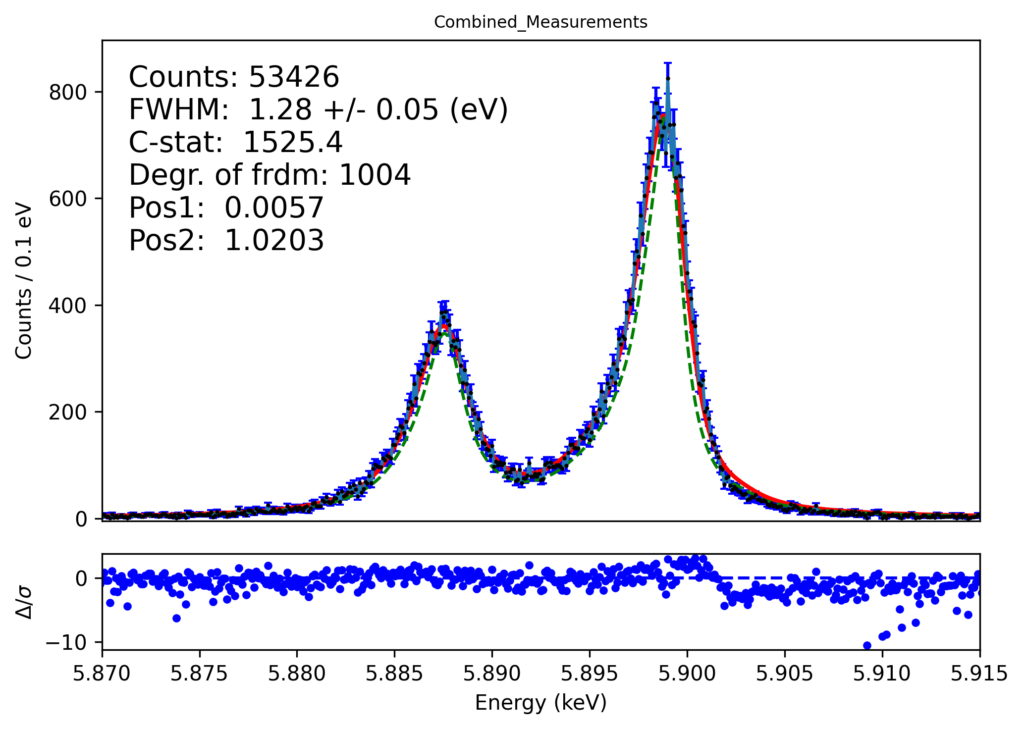
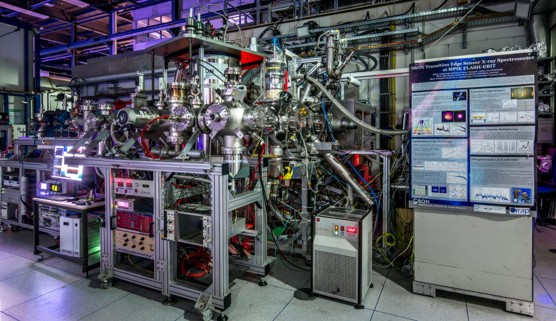
Dedicated frequencies
To understand FDM, it is helpful to think of an old AM radio. Each radio station broadcasts at a dedicated frequency, and the music is encoded in the amplitude of the tone at that frequency. This way, many radio stations can broadcast simultaneously without interference. Similarly, in FDM each TES is biased with an alternating current at a unique carrier frequency, typically in the MHz range for X-ray microcalorimeters and in the kHz–MHz range for infrared bolometers. When an X-ray photon or infrared signal is absorbed, the electrical resistance changes, modulating the amplitude of its carrier signal. All modulated signals from the multiplexed pixels are summed and amplified by a superconducting quantum interference device (SQUID) amplifier. By demodulating the combined signal at the individual carrier frequencies, the response of each TES can be recovered with minimal cross talk. To make this possible, SRON has developed broad expertise in the fabrication of lithographic LC resonators and superconducting transformers.
Next generation
This FDM technology developed at SRON has demonstrated space-level performance in terms of noise, linearity, and scalability, making it well suited for next-generation astrophysical space instruments. For X-ray spectroscopy, FDM enables high count-rates and high energy resolution in large-format microcalorimeter arrays, while for (far-)infrared and microwave applications it supports bolometric imaging with thousands of pixels. Ongoing developments at SRON focus on increasing multiplexing factors, improving resonator uniformity, and optimizing digital feedback and signal processing.
Wide range of domains
SRON’s FDM technology can be used across a wide range of scientific and technological domains. In astrophysics, FDM has been considered as a competing technology for ESA’s NewAthena X-ray observatory, where large TES arrays will deliver high-resolution X-ray spectroscopy of the hot gas within clusters of galaxies and the surroundings of black holes. For cosmology, FDM is being developed for LiteBIRD, which relies on large arrays of infrared and millimeter-wave TES bolometers to measure the polarization of the cosmic microwave background with unprecedented sensitivity. Beyond space science, TES detectors with FDM readout are increasingly used in fusion research or material analysis, demonstrating the versatility of this technology well beyond its astronomical origins.