



To find out how special the Earth is in the context of the Universe, we must study lots of planets, including those orbiting other stars. SRON is developing technology to bridge the extreme contrast between star and planet using mirrors capable of adjusting their shape with nanometer precision.
The major problem with studying exoplanets is the overwhelming light from the adjacent star. We need that star to illuminate the planet, but at the same time that spotlight is pointed directly at us. Taking the Earth and Sun as an example, the visible light from a star is ten billion times brighter than the planet situated right next to it. The challenge is comparable to studying a firefly flying right next to a helicopter with its searchlight pointed straight at you.
-
Coronagraphs

-
Deformable Mirror
-
The planet remains present
-
SRON’s Expertise
Coronagraphs
To shield off the star, SRON develops coronagraphs. These are masks that block direct starlight. However, a coronagraph alone is not sufficient. Even imperfections on the nanometer scale in telescope mirrors cause starlight to leak past the mask and become scattered. This creates a pattern of light spots—known as speckles—that mimic planets. They are often the same size as the planet we are looking for, and sometimes even brighter than that. This creates a two-way problem: the speckles cause confusion because we do not know which spot is the planet, and they often overlap with the planet, rendering analysis impossible.

Deformable Mirror
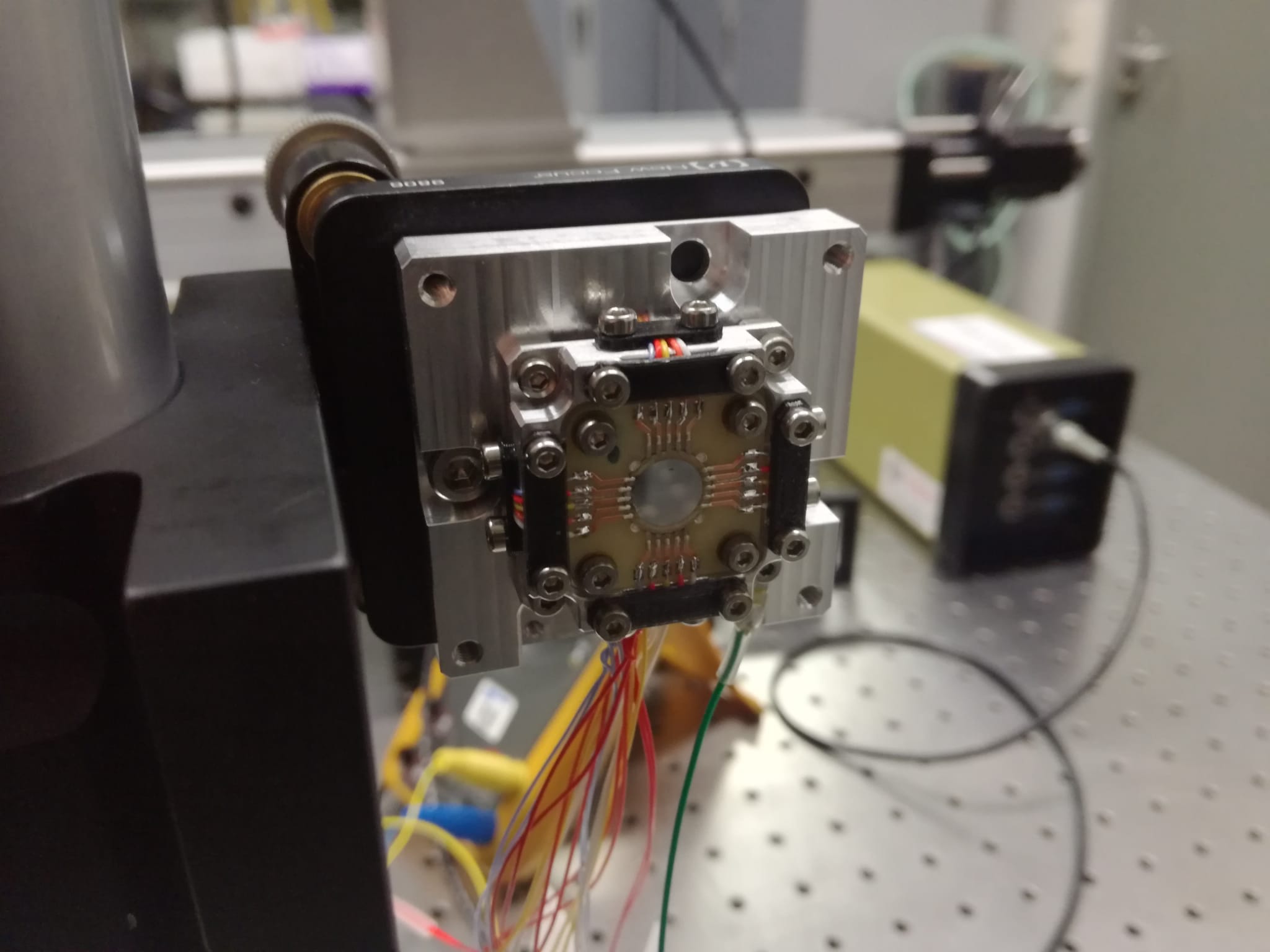
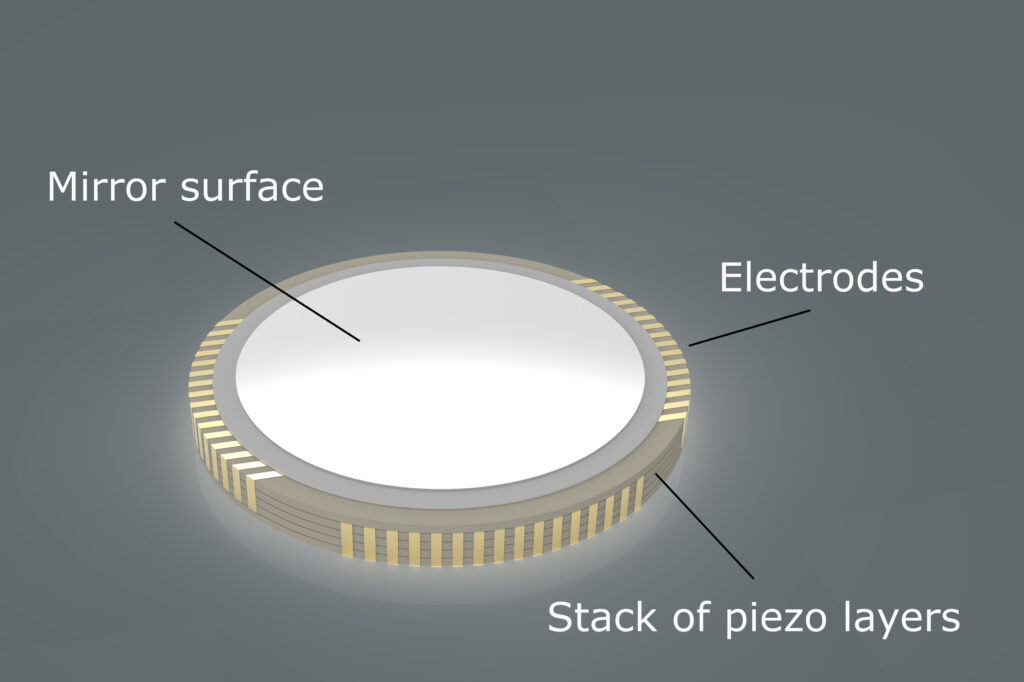
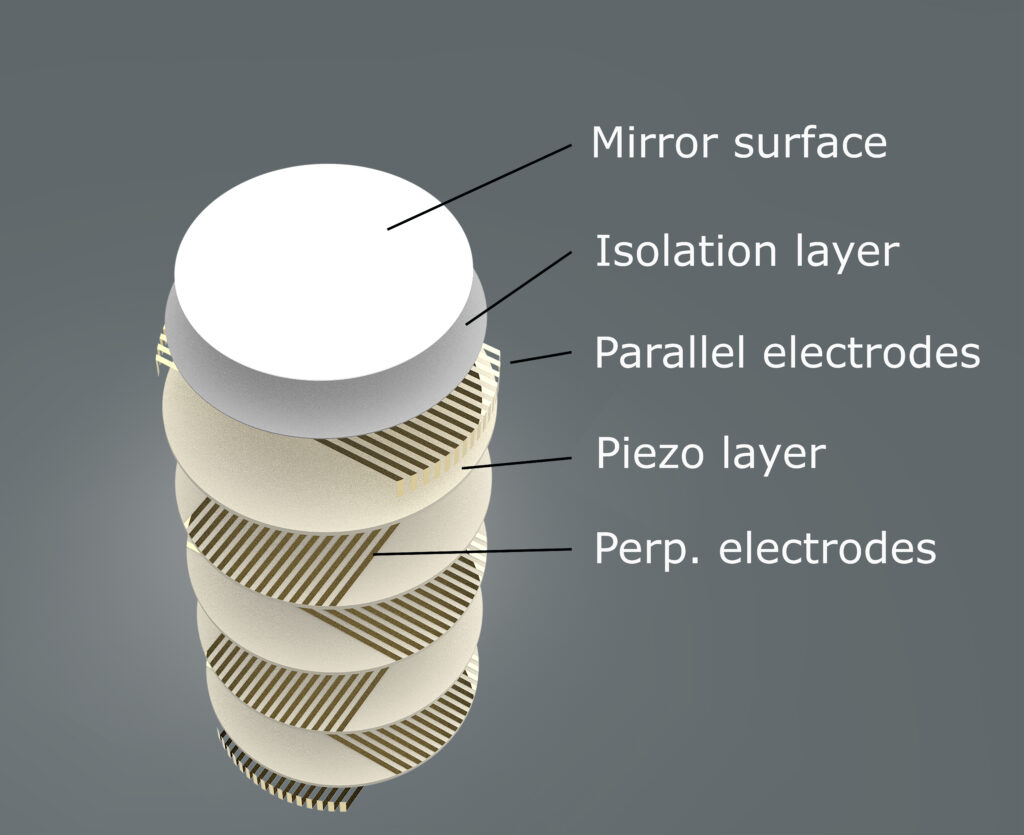
To get rid of the leaking starlight as well, SRON is developing deformable mirrors in collaboration with the University of Groningen. Beneath their surface lie hundreds to thousands of small actuators that locally indent or push out the surface. This technology exploits the wave nature of light. Just like a funhouse mirror distorts an image, we can use deformable mirrors to actually correct a distortion.
The planet remains present
The mirror only corrects for one specific direction of incidence. Because the star and the planet are located at different positions on the sky, the light from the planet enters the telescope at a slightly different angle. The correction made by the mirror is specifically calculated to cancel out the light originating from the star’s position on the sky. Therefore, the light from the planet, arriving from a location just next to it, is left undisturbed.
Wavefront Sensing & Control
Before you can correct anything, you must first know what the problem is. SRON develops software that analyzes errors in the telescope image, called Focal Plane Wavefront Sensing. This software calculates in real-time the shape the mirror must adopt, with picometer-level accuracy.
Hysteretic Mirrors
Traditional deformable mirrors require continuous power to maintain their shape, which generates heat. Exoplanet telescopes primarily observe in visible and infrared light, which has the same wavelength as the thermal radiation from the mirror. If there is too much heat, they are observing their own mirror rather than the sky. Furthermore, the heat also affects the scientific instrument.
For this reason, SRON is developing Hysteretic Deformable Mirrors. These use piezoelectric elements that deform when a voltage is applied. The mirror consists of material that retains its new shape even when the voltage is removed. This results in less thermal radiation and also saves scarce energy. Moreover, the concept is realistically scalable to over ten thousand actuators. That order of magnitude is required for a mirror in future exoplanet telescopes.
Testing under cryogenic conditions
In space, equipment often operates at temperatures close to absolute zero, around -270°C, to avoid noise from thermal radiation and to enable detection technologies based on superconductivity to function. In these extreme circumstances, materials shrink and change properties. SRON possesses cryogenic laboratories to test technologies under the harsh conditions of space.
Relevant Missions
Deformable mirrors are a candidate technology for use in the following missions:
- ELT / METIS: The Extremely Large Telescope in Chile will be the largest telescope in the world. SRON is developing the software that will control the deformable mirror for the METIS instrument.
- Habitable Worlds Observatory: The specific goal of this mission is to directly image Earth-like planets. SRON is a candidate to supply the deformable mirror technology for this.
- LIFE: The Large Interferometer For Exoplanets, an initiative of European institutes including SRON, aims to investigate the atmospheres of exoplanets in detail. Also in this project, SRON’s deformable mirrors are a candidate to serve as mirrors.
Relevant subjects

Our experts
-
 Read more
Robert Huisman
