



| Status | Legacy |
| Launch | 2009, 2010, 2011 |
| Space organisation | DLR |
| Type | Far-infrared (167 – 625 µm) |
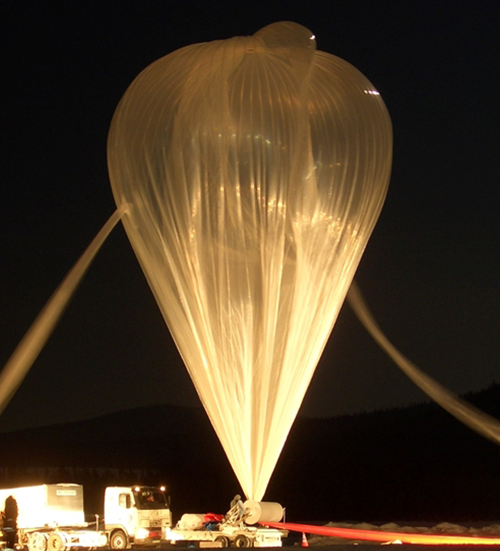
| Orbit | Balloon flight above Arctic (34 km) |
| SRON contribution to | Superconducting Integrated Receiver channel |
The Earth’s atmosphere consists predominantly of nitrogen and oxygen. In addition, there are various trace gases present that, despite their small quantities, impact our climate and the protective ozone layer. TELIS was designed to map these gases in the lower stratosphere and upper troposphere; between ten and forty kilometers in altitude. Scientists used TELIS to measure short-lived, reactive molecules that play a key role in ozone chemistry, such as hydrogen chloride, chlorine monoxide and ozone itself.
The mission utilized a technique called limb sounding. Instead of looking straight down, TELIS looked sideways, towards the ‘edge’ or limb of the atmosphere. This provides a vertical resolution of approximately two kilometers, enabling scientists to distinguish between chemical processes at specific altitudes.

TELIS is a so-called cryogenic heterodyne spectrometer. Heterodyne technology mixes the incoming, high-frequency signal from the atmosphere with a locally generated reference signal, making it easier to analyze. The receivers used for this are superconducting and only operate at temperatures below 4 Kelvin, or -269 °C. TELIS features three channels: 450-660 GHz, 499-503 GHz, and 1790-1870 GHz. The first channel was developed by SRON.
SRON built its channel based on Superconducting Integrated Receiver (SIR) technology. Typically, the components of a heterodyne receiver consist of separate, relatively bulky parts, such as the antenna, the mixer, and the local oscillator. IREE succeeded in integrating all these superconducting elements onto a single microchip measuring just 4 by 4 millimeters. This miniaturization saved a significant amount of space and weight, which are scarce commodities in space exploration.
Our experts
-
 Read more
Ruud Hoogeveen
Senior Instrument Scientist, Senior Project Manager

