



| Status | Legacy |
| Launch | 2015 |
| Space organisation | ESA |
| Type | Gravitational waves |
| Orbit | Heliocentric (L1) |
| SRON contribution to | Data analysis |
The Laser Interferometer Space Antenna (LISA) will be launched in the mid-2030s. Instead of capturing electromagnetic radiation—such as infrared, X-rays or visible light—it will capture gravitational waves. It ‘listens’ to the Universe rather than ‘looking’ at it. Gravitational waves are vibrations of space just as sound waves are vibrations in the air.
As a precursor to LISA, LISA Pathfinder could not detect gravitational waves itself, but provided the fundamental proof that we can measure these waves from space. LISA will be the first space detector to actually do this. With arms of 2.5 million kilometers, it is sensitive to longer wavelengths than a ground-based detector will ever be able to observe.
Short and long wavelengths
Detectors on Earth listen to shorter wavelengths, enabling them to observe black holes or compact stars colliding with such violence that they can still be heard millions of light-years away. Collisions between even larger objects generate waves with longer wavelengths, which are only audible to detectors with a span width much larger than Earth. LISA is sensitive to wavelengths between one hundred thousand and one billion kilometers.
Supermassive black holes
Collisions between supermassive black holes fall within LISA’s range, as do objects and events from the distant universe whose gravitational waves are stretched by the cosmic expansion of the Universe. Thus, LISA will be the first to perform measurements on the period immediately after the Big Bang, when the Universe likely expanded at an unprecedented rate. Furthermore, astronomers hope to use LISA to observe the seeds of supermassive black holes in the first hundreds of millions of years of the Universe.

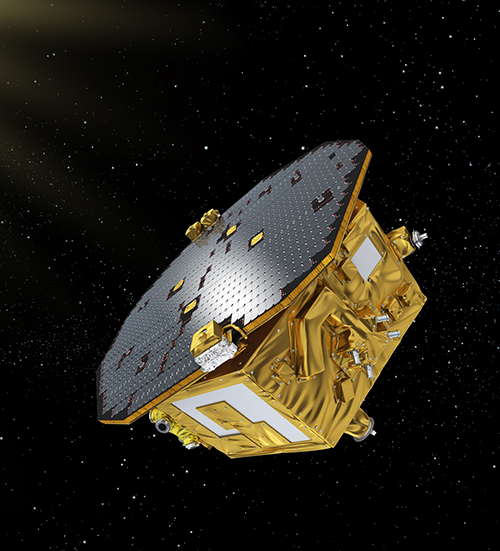
The greatest technological challenge for measuring gravitational waves is silence. Not in terms of sound, but in terms of motion. To measure a gravitational wave, we must be able to monitor the distance between two objects with an accuracy of a picometer (a trillionth of a meter). The housing must shield the objects from any force other than gravity, such as the solar wind or magnetic fields, so that they are in a perfect free fall.
The heart of LISA Pathfinder was the LISA Technology Package (LTP). This contained two gold-platinum cubes — the test masses — floating freely inside the satellite. The satellite acted as a shield against external disturbances affecting the test masses. Using micro-thrusters, the satellite ensured it followed the movement of one of the test masses with extreme precision, allowing it to remain in perfect free fall. The motion of the other mass was loosely controlled via an electrostatic force so that it followed the free-falling one. The movement of both test masses was monitored by the satellite to determine how well free fall was achieved.
Technology is mature
Measurements showed that the disturbing forces on the test masses were suppressed even stronger than the strict requirements prescribed. Although the distance of 38 centimeters between the test masses was too small to actually capture gravitational waves, the measured stability demonstrated that the technology is ready for it. With this, LISA Pathfinder paved the way for the construction of the large LISA mission.
SRON’s contribution
For LISA Pathfinder, SRON delivered the unit that replaced the function of the test masses during ground tests, named Inertial Sensor Special Check-Out Equipment (IS-SCOE). The IS-SCOE electronics had to be just as precise and low-noise as in the satellite. This allowed the ground test to demonstrate that a free fall of the test masses would be possible. SRON used LISA Pathfinder for what it was intended: as a learning ground to subsequently build components for the actual LISA mission. For this, it is developing, among other things, the photodiodes that detect the inter-satellite infrared laser beams and the control system for the pointing mechanism of those laser beams.
Our experts
-
 Read more
Pieter Dieleman

