

| Status | Legacy |
| Launch | 1995 |
| Space organisation | ESA |
| Type | Infrared (2.5 – 240 μm) |
| Orbit | Elliptical geocentric (1,000 – 70,000 km) |
| SRON contribution to | Short Wavelength Spectrometer (SWS) |
The wavelength range of the SWS coincided with the infrared wavelengths at which cool objects with temperatures of 80-1500K emit most of their energy. The spectral resolution of the SWS made it possible, for example, to study the atmosphere of the gas planets in our solar system and the composition of the soil of Mars and asteroids. In addition, the SWS provided spectra of objects outside our Milky Way. Among other things, astronomers have discovered that galaxies that shine brightly in the infrared have recently undergone a period of intense star formation. Because the SWS was able to detect hydrogen molecules in their lowest energy state, astronomers learned a great deal about how space clouds cool down to eventually form stars.
Comets
Before ISO, we thought comets were fairly straightward “dirty snowballs” consisting of pristine primordial material from interstellar space. However, ISO’s spectra revealed something quite different. Comets were found to also consist of minerals and Polycyclic Aromatic Hydrocarbons (PAHs).
Crystals
The SWS instrument saw sharp peaks in the spectrum of comet Hale-Bopp that indicated crystalline olivine and pyroxene. This came as a surprise because crystals can only form when stony material becomes very hot, in the order of a thousand degrees, and then cools slowly. However, comets form far away from the Sun, in the Kuiper Belt or Oort Cloud, where it is freezing cold.
The only explanation for the presence of crystals is that our solar system was extremely turbulent in its infancy. Material that was heated and crystallised close to the young Sun must have been transported to the outer regions and clumped together with ice to form comets. In this way, ISO changed our view of the baby solar system from a static disc to a wild, turbulent vortex.
PAHs
ISO’s detection of PAHs in comets established a direct link between the chemistry of the Universe and our own solar system. PAHs are complex organic molecules consisting of rings of carbon and hydrogen. On Earth, they are found in soot and exhaust fumes, but in space they are ubiquitous in star-forming regions. ISO confirmed the presence of these complex molecules in the gas cloud surrounding the comet’s nucleus.
This shows that complex organic molecules from interstellar gas can survive the formation process of the solar system. Because comets often struck the young Earth during the infancy of the solar system, the presence of PAHs suggests that comets brought a large amount of organic material to our planet. This may have formed the basis for the emergence of life.
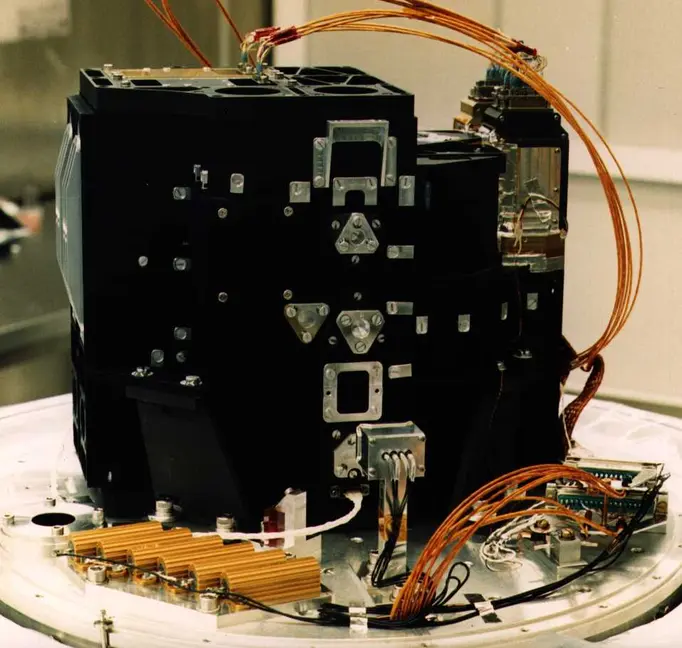
The SWS was one of four instruments onboard ISO. The instrument consisted of two almost independent grating spectrometers, one for short infrared wavelengths of 2.4 – 12 µm and one for long infrared wavelengths of 12 – 45 µm, with a spectral resolution between 1500 and 2000. The SWS had 17 wavelength bands, 3 apertures and 6 detector arrays. The detectors were housed in a cryostat cooled to four degrees above absolute zero (4 Kelvin) with superfluid helium.