



| Status | Legacy |
| Launch | 1980 |
| Space organisation | NASA |
| Type (HXIS) | X-rays (0,04 – 0,35 nm / 3,5 – 30 keV) |
| Orbit | Geocentric (574 km) |
| SRON contribution to | HXIS |
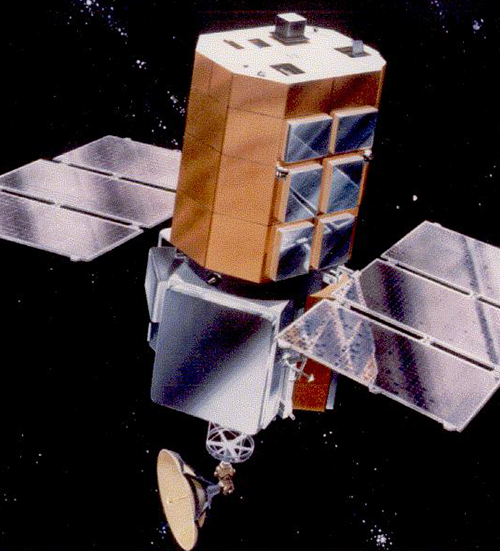
SMM was specifically designed to study the Sun during a ‘solar maximum’, the period in the 11-year solar cycle when it exhibits the highest level of activity. The mission provided a better understanding of solar flares, the solar wind and coronal mass ejections (CMEs).
Among other things, SMM demonstrated that X-rays are emitted from the base of the magnetic loops that protrude from the solar surface. It also observed X-ray emissions from two widely separated locations on the surface prior to a Coronal Mass Ejection (CME).
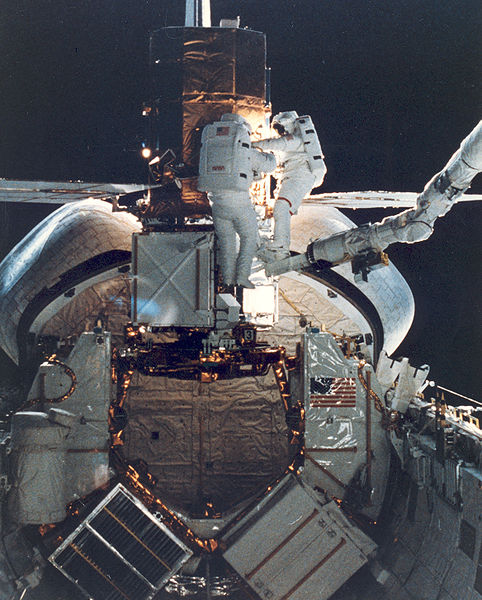
Ten months after launch, a fuse blew in the attitude control system, preventing the satellite from accurately pointing at the Sun. SMM was subsequently placed in standby mode. In 1984, astronauts traveled to SMM aboard the Space Shuttle Challenger to capture it from orbit, repair it in Challenger’s payload bay, and subsequently release it back into space. Ultimately, SMM remained operational until 1989.

SMM was equipped with a suite of seven instruments that together could measure the entire spectrum of solar activity, from visible light to gamma radiation. SRON was responsible for the Hard X-ray Imaging Spectrometer (HXIS), which it developed in collaboration with the University of Birmingham.
Before SMM, scientists measured X-rays coming from the Sun, but could not exactly locate their source on the Sun. X-rays are difficult to focus with standard lenses. SRON engineers therefore built the imaging system using a ‘grid collimator’. This consists of ten grid plates placed one behind the other, with 350,000 holes per plate. They aligned these in such a way that many viewing tubes were created. This posed a significant challenge in terms of mechanical and thermal stability, because the grid plates were not allowed to shift by more than two microns during launch.
The viewing tubes ensured that only light from a specific patch of the sky, or in this case a patch of the solar surface, fell onto a pixel. In this way, the instrument produced the first images of high-energy solar flares in the range of 3.5 to 30 keV, with a spatial resolution of eight arcseconds. The time interval between observations varied from 1.5 to eight seconds.

