



| Status | Legacy |
| Launch | 1989 |
| Space organisation | ESA |
| Type | Visible light (375 – 750 nm) |
| Orbit | Elliptical geocentric |
| SRON contribution to | Star detection system and software |
The Hipparcos mission marked the birth of space astrometry. To determine the distances to stars via parallax, Hipparcos had to measure their positions in the sky with high accuracy. In space, the satellite avoided interference from atmospheric turbulence. As Hipparcos orbited the Sun alongside the Earth, it effectively moved across a baseline of twice the Earth-Sun distance relative to the stars over the course of a year. Meanwhile, Hipparcos determined the extent to which a star’s position in the sky shifted. The further away a star is, the less it appears to move back and forth. Imagine a distant tree line that hardly seems to move when viewed from a car, whereas trees right next to the road flash by. The mission resulted in the Hipparcos and Tycho catalogues. The former contained the positions, distances, and proper motions of over 118,000 stars. The latter contained data of a million stars, albeit with lower precision.
Cepheids
Among the stars in these catalogues were Cepheids, which can serve as cosmic standard candles. Cepheids contract and expand in a regular pattern, causing them to vary in brightness. The time period over which they do this correlates with their (maximum) intrinsic brightness. However, because their distances were not precisely known, astronomers only knew how bright they appeared, not how bright they actually were. The scale on the ruler was unclear.
Cosmic Distance Ladder
Because Hipparcos measured the distances to a number of these Cepheids, astronomers could calibrate them and thus establish a formula for the absolute brightness corresponding to the length of a variation cycle. For the many other Cepheids, they simply had to time the cycle, from which the absolute brightness could be derived. By comparing this to the apparent brightness, it is then easy to determine the distance. In this way, they refined the ‘cosmic distance ladder’, which is used to determine the size and expansion rate of the Universe. The catalogues also provided insight into stellar evolution and the dynamics of our Milky Way. Hipparcos is considered the direct predecessor to the later, even more advanced Gaia mission.

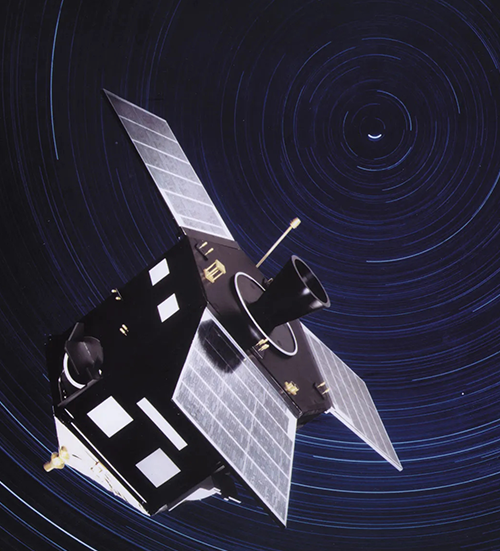
The Hipparcos satellite was built around a Schmidt telescope with a 29-centimeter split mirror. This combined two different star fields, separated by 58 degrees, into a single field-of-view. Both fields acted as a frame of reference for each other to measure star positions more accurately.
In the focal plane of the telescope was a grid with 2,688 narrow slits. As the satellite slowly spun around its axis, the starlight moved across this grid. This caused the detector to see a star constantly blinking on and off. From the precise timing of this blinking—or rather, the exact moment the light passed through a slit—Hipparcos derived the star’s position. By comparing the timing of stars that were far apart, the satellite could determine their relative angular distance.
SRON’s Contribution
SRON built the star detection system for Hipparcos. This consisted of two Image Dissector Tubes, four photomultiplier tubes, readout electronics, and the electrical and mechanical interfaces that connected the tubes to the satellite. Furthermore, SRON participated in the FAST consortium, which developed software for processing the satellite data.