



| Status | Legacy |
| Launch | 1983 |
| Space agency | ESA |
| Type | X-rays (0,025 – 25 nm / 0,05 – 50 keV) |
| Orbit | Highly elliptical geocentric |
| SRON-contribution to | Low Energy Imaging Telescopes |
Apart from the scientific instruments onboard, EXOSAT’s distinctive feature was its orbit. Most satellites revolve around the Earth in a Low-Earth Orbit, causing observed sources to disappear behind our planet every 90 minutes, constantly interrupting the observations. EXOSAT’s orbit reached up to 190,000 km. This allowed the X-ray telescope to observe a single object continuously for up to ninety hours without the Earth blocking its view. This provided crucial insights into changes over time.
Quasi-Periodic Oscillations
One of EXOSAT’s most significant discoveries were Quasi-Periodic Oscillations (QPOs) in low-mass X-ray binaries. The satellite observed that the X-ray emission from certain neutron stars flickered rapidly and regularly. This gave astronomers insight into how matter behaves just above the surface of a neutron star. EXOSAT also captured full cycles of X-ray bursts on neutron stars—thermonuclear explosions occurring on their surface.
Active Galactic Nuclei
In the age of EXOSAT, astronomers wanted to understand why the cores of other galaxies emit X-rays. These are called Active Galactic Nuclei (AGN). Using EXOSAT, they discovered that the brightness of AGN varies on timescales of just hours or days. Because light takes time to travel, this rapid variation implied that the source had to be physically small; certainly no larger than a few light-days, or roughly the size of our solar system. After all, if a source stops shining, the light emitted from the backside takes longer to arrive than the light from the front, and this delay increases with the size of the object. This provided evidence that the enormous energy production could not originate from an extended cluster of stars, but had to be produced by a single, compact supermassive black hole.

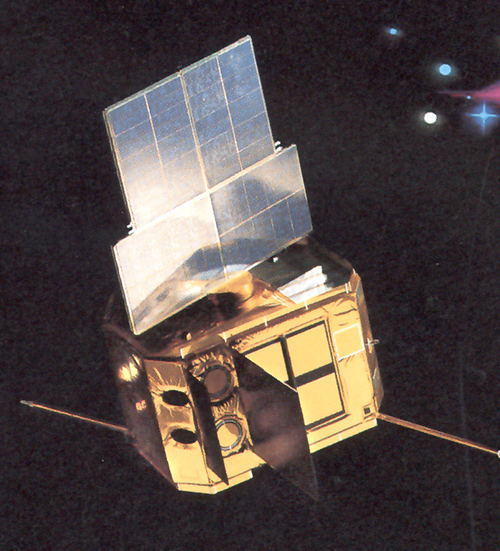
X-rays are difficult to capture because they pass straight through most materials, including mirrors. Therefore, EXOSAT used ‘grazing incidence mirrors’ (Wolter telescopes), where the radiation enters at a shallow angle of less than one degree and is reflected toward the detector.
SRON’s Contribution
SRON supplied the transmission gratings for the two Low Energy Imaging Telescopes (0.05 – 2 keV) on board. These dispersed the X-ray light into a rainbow to create a spectrum from which the fingerprints of chemical elements could be read. The gratings consisted of thousands of micrometer-thin gold wires, with a spacing of only a few micrometers, amounting to hundreds of lines per millimeter. They produced spectra in which astronomers could see the fingerprints of elements in the hot coronas of stars, the accretion disks around compact objects, and the remnants of exploded stars.
SRON’s transmission gratings for EXOSAT laid the foundation for later contributions to missions such as Chandra and XMM-Newton.
Our experts
-
 Read more
Jan-Willem den Herder

