


| Status | Active |
| Launch | 2004 |
| Space organisation | NASA |
| Type (OMI) | Visible / UV (270 – 500 nm) |
| Orbit | Geocentric (705 km hoogte) |
| SRON contribution to | OMI |
EOS-Aura was launched during a period of major concern regarding the hole in the ozone layer and increasing air pollution. Thanks to the long operational lifespan of EOS-Aura, scientists have been able to build an extensive, long-term data record. This data allowed them to determine whether international treaties, such as the Montreal Protocol, were effectively reducing chlorofluorocarbons (CFCs) and aiding the recovery of the ozone layer.

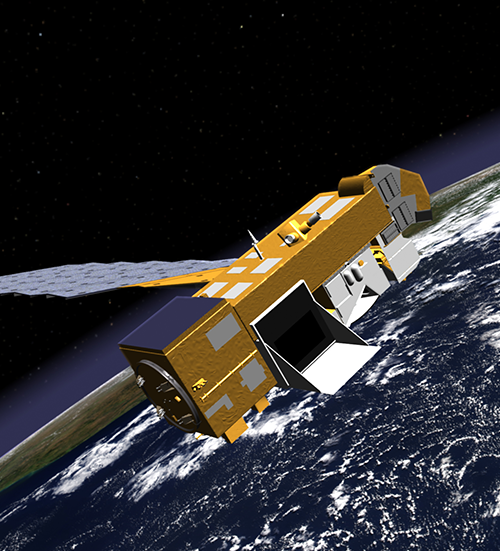
The EOS-Aura satellite carries four instruments that collectively scan the atmosphere. SRON contributed to the Ozone Monitoring Instrument (OMI), which measures spectra in UV and visible light. OMI is a collaborative effort between the United States, the Netherlands, and Finland, with scientific leadership provided by KNMI.
Unlike its predecessors, which used a scanner to move the field-of-view back and forth, OMI uses a CCD detector. This sensor sweeps its field-of-view across the Earth’s surface like a broom — a technique known as “push-broom” scanning — covering a wide track with a swath width of 2600 km. This allows the instrument to map the entire planet daily with a spatial resolution of 13 x 24 km — unprecedented until 2017.
During the preliminary testing of the OMI instrument, SRON supplied the Electrical Ground Support Equipment (EGSE) used to control and readout the instrument. SRON engineers also assisted in the assembly of the instrument, its integration onto the satellite, and its calibration.
The technology and expertise acquired through OMI formed the foundation for its successor: the Dutch TROPOMI instrument on the Sentinel-5p satellite, as well as the Sentinel-5 instrument on Metop-SG.
Our experts
-
 Read more
Ruud Hoogeveen
Senior Instrument Scientist, Senior Project Manager