


| Status | Active |
| Launch | 2005 |
| Space organisation | ESO |
| Type | Far-infrared (0.2 – 1.5 mm) |
| Orbit | Atacama desert, Chile |
| SRON instrument | AMKID |
Dark ages
During the first billion years of the universe, the first stars slowly began to form. However, because they were still shrouded in dense clouds of hydrogen, they remained hidden from our view. This era is therefore known as the “dark ages”. After that, more and more stars formed and the first galaxies emerged, while the hydrogen nebula cleared.

Far-infrared
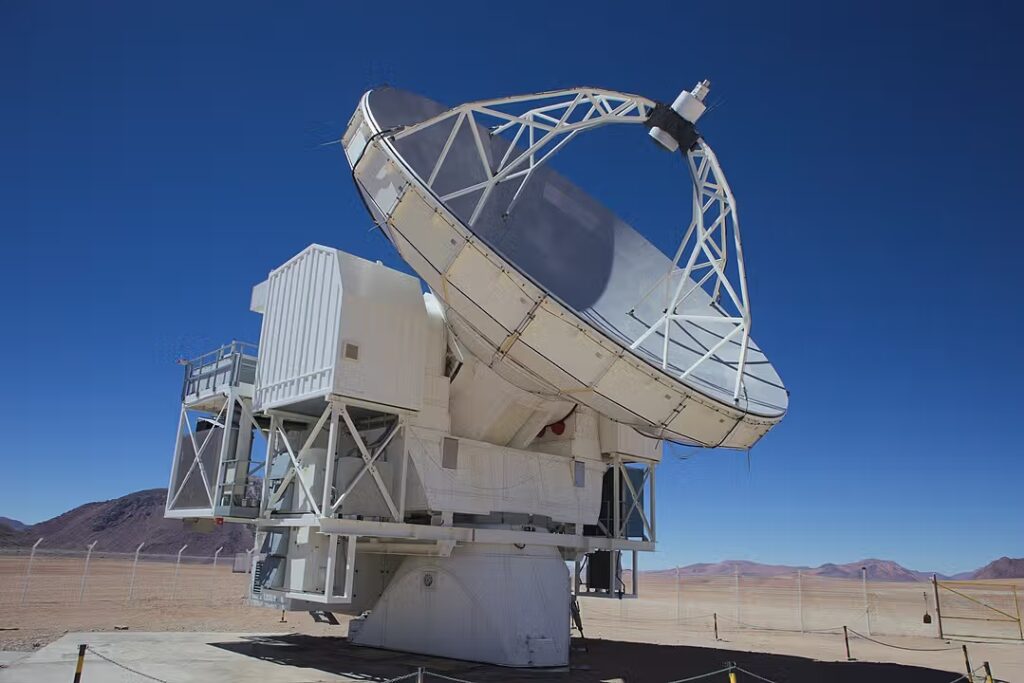
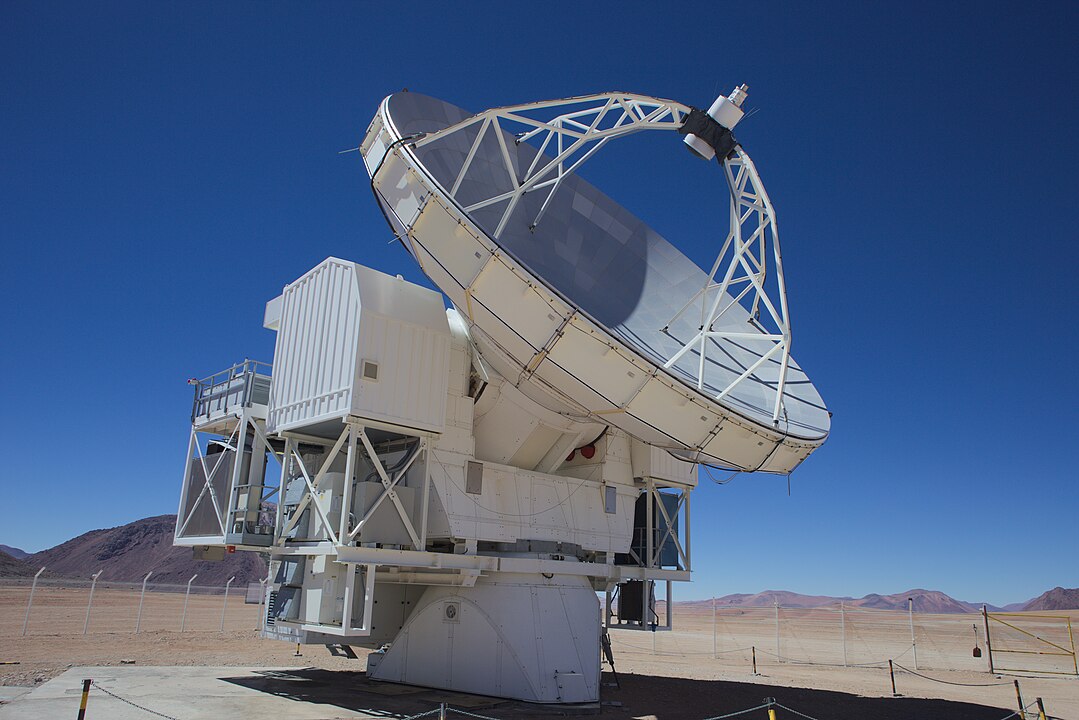
The light from those first stars has been stretched by the expansion of the universe during its long journey through space and time. The light that was originally in the visible wavelength range has changed into far-infrared radiation by the time it reaches Earth. APEX captures this radiation with its 12-metre wide dish. A dish of such a magnitude is necessary because the light has weakened considerably after travelling over ten billion light-years. And because far-infrared radiation is blocked by the Earth’s atmosphere, APEX is located at an altitude of over 5,000 metres in one of the driest areas in the world.
AMKID
AMKID uses over 17,000 pixels to photograph the earliest galaxies in the Universe. They are divided into two colours – at 0.35 and 0.85 mm wavelength – which provides astronomers additional information when mapping the formation of galaxies during the early period of the universe.
SRON and TU Delft supplied the detectors for this instrument – Kinetic Inductance Detectors (KIDs). These work on the basis of a physical phenomenon called kinetic induction. This manifests itself at temperatures close to absolute zero, at the point where the material becomes superconducting.
The instrument itself was developed by the Max Planck Institute for Radio Astronomy in Bonn.
Our experts
-
 Read more
Jochem Baselmans
SENIOR INSTRUMENT SCIENTIST @ SRON AND PROFESSOR @ TU DELFT (PROF. DR. IR.)