



Astronomer Akira Endo, working from TU Delft in collaboration with SRON, is developing a method to create a three-dimensional map of the early universe. Due to the expansion of the Universe, the light from the earliest galaxies reaches our telescopes as far-infrared radiation. Therefore Endo is developing a chip containing eighty small far-infrared spectrometers. Because each pixel can distinguish between colors, it can determine whether galaxies are farther or closer depending on how much their light is redshifted. Endo has now received an NWO Vici grant to conduct this research.
Young Cosmic Web
In the early universe, the large-scale distribution of dark matter and galaxies formed the cosmic web. Galaxies grew and merged, while stars formed at a rapid pace. To learn more about the distant, dust-enshrouded galaxies in the early universe, astronomers study far-infrared light that has traveled for billions of years before reaching Earth.
Instead of relying solely on individually visible galaxies, astronomers can also study the faint glow collectively produced by many young galaxies. This widespread glow carries a hidden imprint of how matter was arranged in the early universe. Astronomer Akira Endo is working from TU Delft in collaboration with SRON on a new instrument called TIFUUN to reveal this imprint.

TIFUUN
By observing the glow of ionized carbon alongside individually detected bright galaxies, Endo and his team will map the ‘cosmic web’ where galaxies originated. TIFUUN features pixels capable of distinguishing between colors, allowing them to determine the redshift of each signal caused by the expansion of the Universe. The redder the signal, the farther away the galaxy is. In this way, the pixels provide not only spatial resolution in a two-dimensional plane, but also in depth. The result should be a 3D map of the early universe, spanning 0.6 to 1.2 billion years after the Big Bang.
80 Spectrometer Pixels
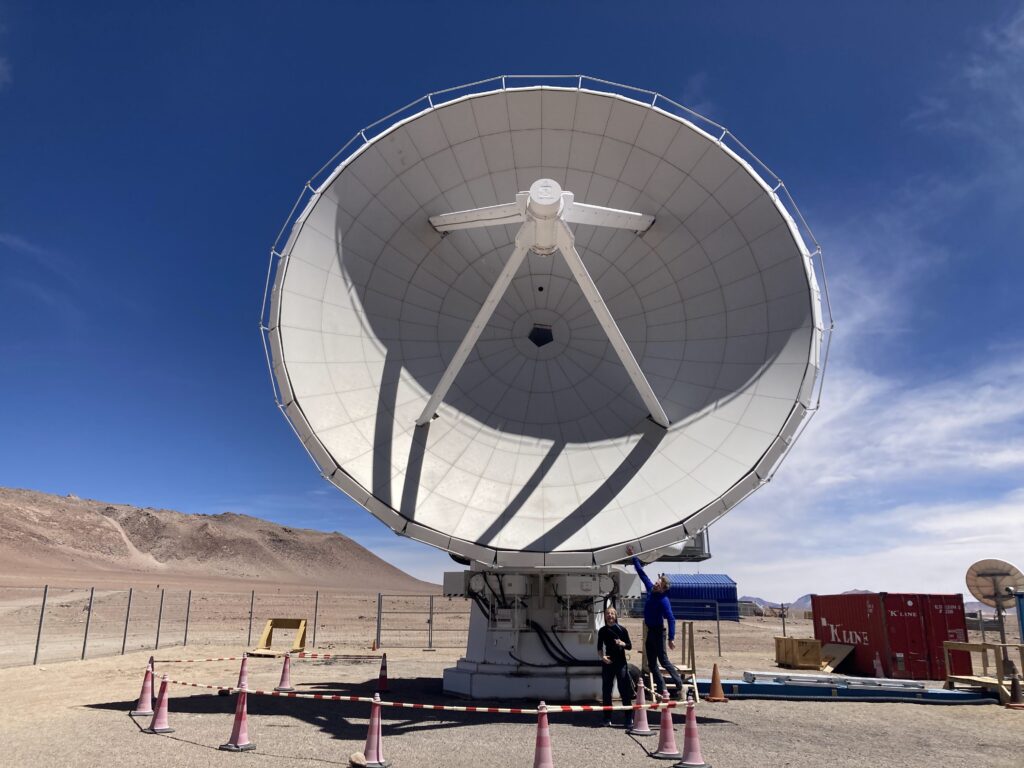
TIFUUN will be installed on the 10-meter ASTE telescope in the Chilean Atacama Desert. The instrument operates across two broad frequency bands, of 130-178 GHz and 195-319 GHz, which will respectively detect the faint collective glow from numerous young galaxies and the brighter signals from individual distant galaxies.
Endo is building upon his previous research with the DESHIMA instrument, which was also developed in collaboration with SRON. DESHIMA is another broadband spectrometer designed to measure the distances and ages of galaxies, but it only had 1 spectrometer pixel. TIFUUN will contain 80 spectrometer pixels. Once TIFUUN is proven to work, it can be scaled up even further.