



Researchers from MPIfR Bonn, SRON and TU Delft have deployed their far-infrared AMKID instrument on the APEX telescope in Chile. With more than 17,000 pixels the AMKID camera is designed to study large areas of the far-infrared sky, providing images of the earliest galaxies in unprecedented detail. AMKID is based on KID detectors that are sensitive enough to observe the background radiation from the Universe. Publication in A&A on March 19th.
To uncover history, scientists usually have to rely on relics that somehow have stood the test of time. In that respect, astronomers have an unfair advantage; they receive information coming directly from the early period of the Universe. Although it depends how you look at it. Astronomers have to observe objects over ten billion light-years away, which means that their light is severely weakened. Moreover, it is stretched to far-infrared wavelengths, which are largely blocked by the Earth’s atmosphere.

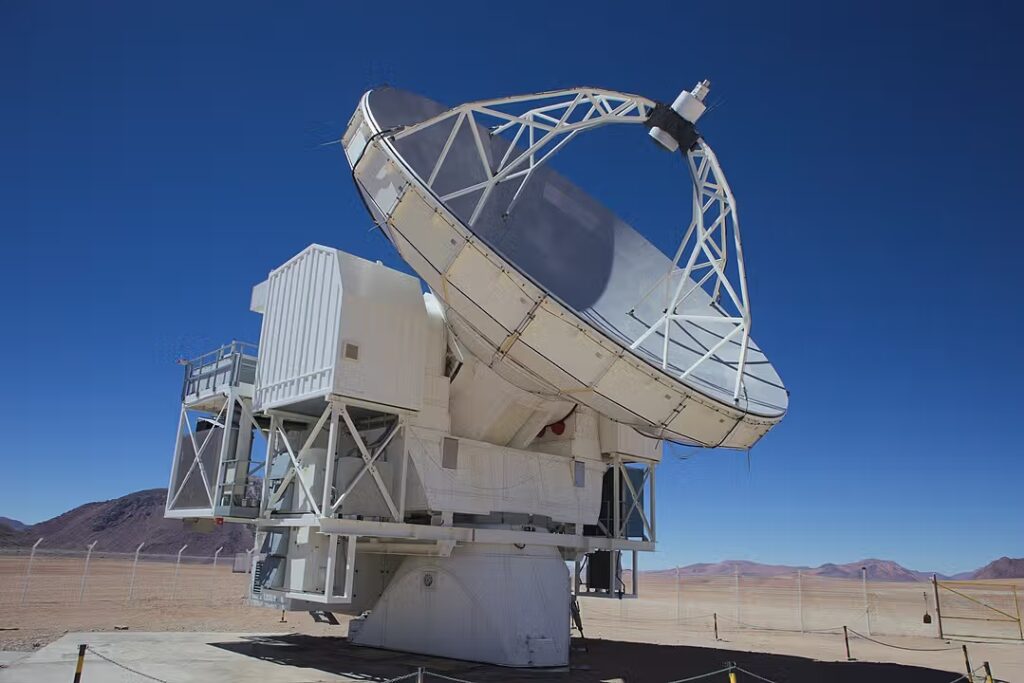
To minimise interference from the atmosphere, researchers from the Max Planck Institute for Radio Astronomy (MPIfR) operate the 12-metre diameter APEX telescope at an altitude of 5,200 meters in the Chilean Atacama Desert. In 2024, they upgraded the telescope by installing the AMKID instrument. The detectors for this instrument were made by SRON and TU Delft.
The Apex Microwave Kinetic Inductor Detector (AMKID) is the largest camera ever made for far-infrared light. With over 17,000 pixels, AMKID can photograph the earliest galaxies in unprecedented detail. They are divided into two colours – at 0.35 and 0.85 mm wavelength – which provides astronomers with additional information as they map the formation of galaxies during the early period of the Universe.
Publication
N. Reyes, A. Weiss, A.M. Baryshev, I. Cámara-Mayorga, G. Grutzeck, C. Heiter, S. Jorquera, A. Kovacs, S.J.C. Yates, R. Güsten, S. Heyminck, S. Hochgürtel, C. König, A. Görlitz, A. Schmitz, A. Endo, L. Ferrari, H. Hoevers, D. Koopmans, N. Llombart, V. Murugesan, M. Ridder, S. Dabironezare D.J. Thoen, A.J. van der Linden, L. Wang, O. Yurduseven, J.J.A. Baselmans and B. Klein, ‘AMKID: A large KID-based camera at the APEX telescope’, Astronomy & Astrophysics