



Astronomers have long debated the role of galaxy mergers in powering active supermassive black holes. Now an unprecedented dataset of a million galaxies from the Euclid telescope provides evidence that mergers play a dominant role and are even the primary trigger for the most luminous black holes.
Almost all massive galaxies harbour a supermassive black hole (SMBH) at their centres. Most of them simply lurk in the dark while quietly reeling in gas, dust and stars from their surroundings. These materials gather in the black hole’s accretion disk before their irreversible dive into the abyss, thereby emitting the only slight hint of radiation that gives away the black hole’s location.

Hypothesis
A small fraction of galaxies possesses an SMBH that shines brightly or even pushes out material from its poles. These are called Active Galactic Nuclei (AGN). Some astronomers have hypothesised that violent collisions between galaxies may play an important role in the ignition of AGN. The resulting turbulence could cause the extra material to pile up in an SMBH’s accretion disk, where friction and compression make it hot enough to shine brightly. In the most extreme cases, the AGN are so bright that they completely outshine their host galaxies.
AI tool
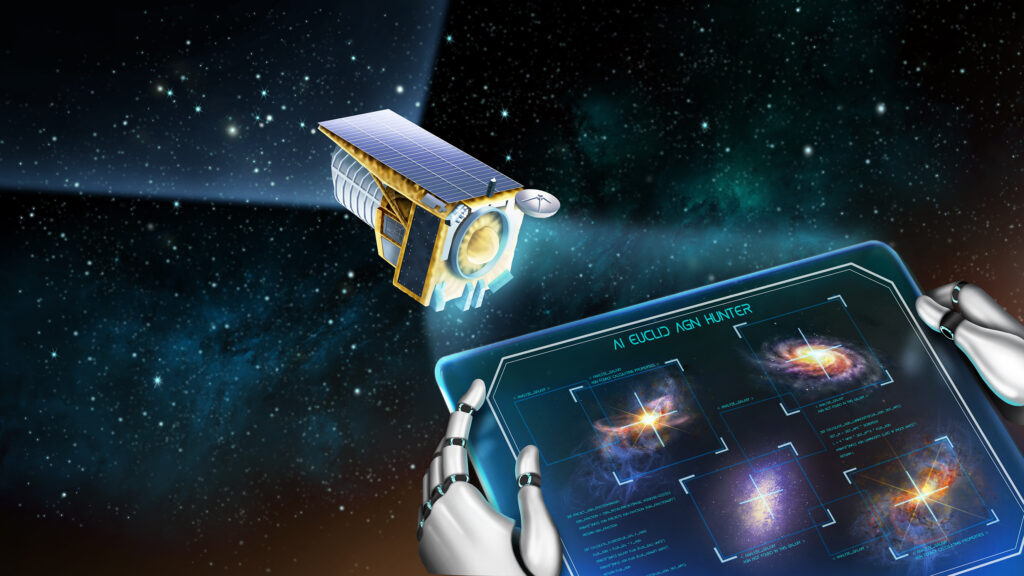
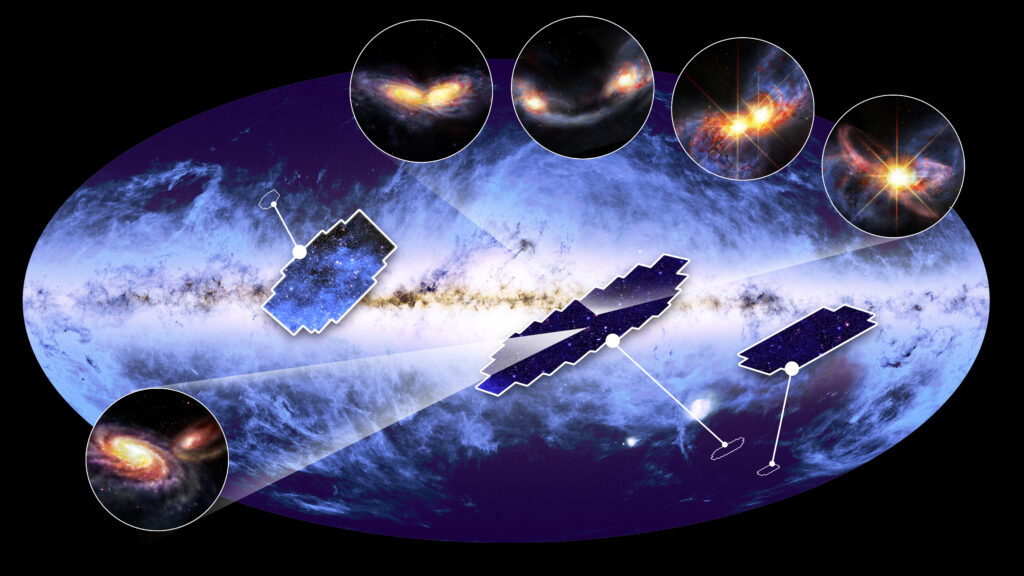
Before the launch of Euclid, validating this hypothesis has been challenging because of limited data quality and small sample sizes. Within one week, Euclid provides higher-quality images covering an area close to the total area observed by the Hubble Space Telescope in over three decades. To fully exploit the power of these data, the Euclid consortium including lead authors Berta Margalef-Bentabol and Lingyu Wang from SRON has developed a novel AI image decomposition tool that not only identifies AGN but also quantifies their output. ‘This new approach can even reveal faint AGN that other identification methods will miss,’ says Margalef-Bentabol.
Hypothesis confirmed
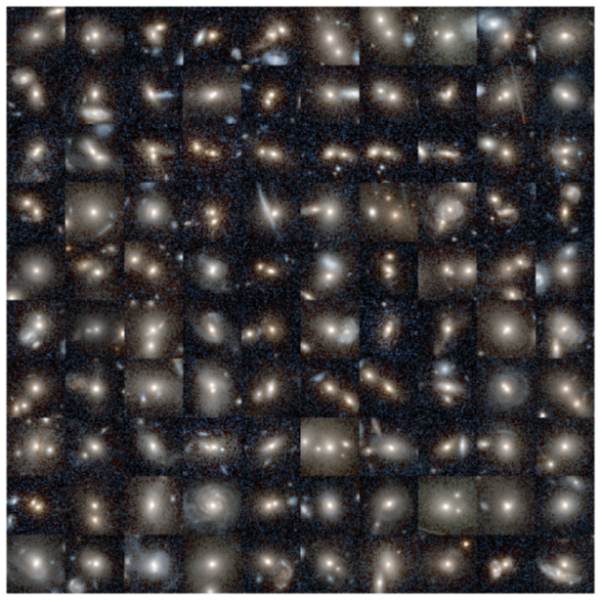
Using the new AGN identification method on a million galaxies, the Euclid consortium including lead authors Antonio la Marca and Lingyu Wang from SRON now confirm the hypothesis that galaxy mergers play an important role in the ignition of AGN. This dataset is dozens of times larger than in previous studies. ‘We also conclude that mergers are very likely to be the only mechanism capable of feeding the most luminous AGN,’ says La Marca. ‘At the very least they are the primary trigger.’
Two to six times more
The team divided the data up in samples of mergers and non-mergers and found that the former contains two or even six times as many AGN compared to the latter. As for the most luminous AGN: the vast majority are found in merging galaxies. In the case of dynamically young and therefore dust-rich mergers, where the AGN is only visible in infrared, there are six times more. In the case of mergers that are coming to completion, where the dust has settled and the AGN is also visible in X-rays, there are twice as many. La Marca: ‘This difference between the two AGN types could mean that many AGN found in non-mergers are actually in merged galaxies that have completed the chaotic stages and appear as a single galaxy in a regular form.’
Publications
These publications appear simultaneously as part of the Euclid Q1 paper splash
‘First Euclid statistical study of galaxy mergers and their connection to active galactic nuclei’, A. La Marca, L. Wang, et al., Astronomy & Astrophysics
Pre-print: https://arxiv.org/abs/2503.15317
‘First Euclid statistical study of the active galactic nuclei contribution fraction’, B. Margalef-Bentabol, L. Wang, et al., Astronomy & Astrophysics
Pre-print: https://arxiv.org/abs/2503.15318