



In the early 2040s, the Habitable Worlds Observatory will search for signs of life in the atmospheres of planets in the Milky Way. However, the detector technology to obtain the required precision does not exist yet. SRON researcher Pieter de Visser has now received an ERC Consolidator Grant to fill this gap over the next five years with his Kinetic Inductance Detectors (KIDs).
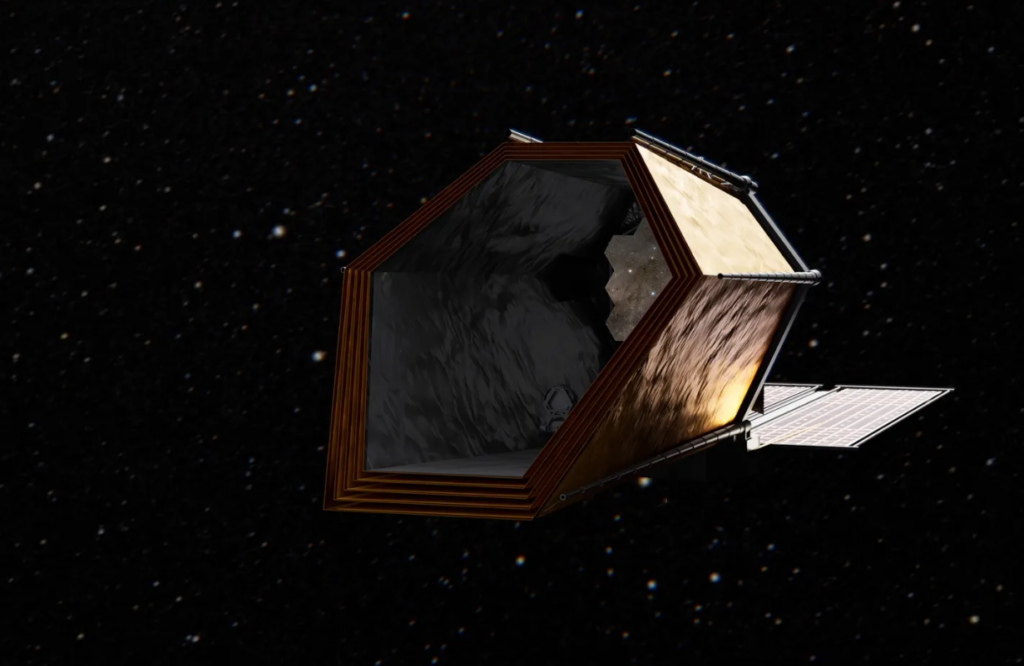
Currently more than six thousand planets have been discovered in our Milky Way. The future PLATO space telescope will add thousands or even tens of thousands to that total from 2026 onwards. Meanwhile, other telescopes are zooming in on their atmospheres, searching for signs of life, called biomarkers. The James Webb Space Telescope has already started this effort, and will be joined by the Ariel space telescope in 2029. A decade later, the Habitable Worlds Observatory (HWO) will take over, mainly to characterise Earth-like planets.

better detection technology
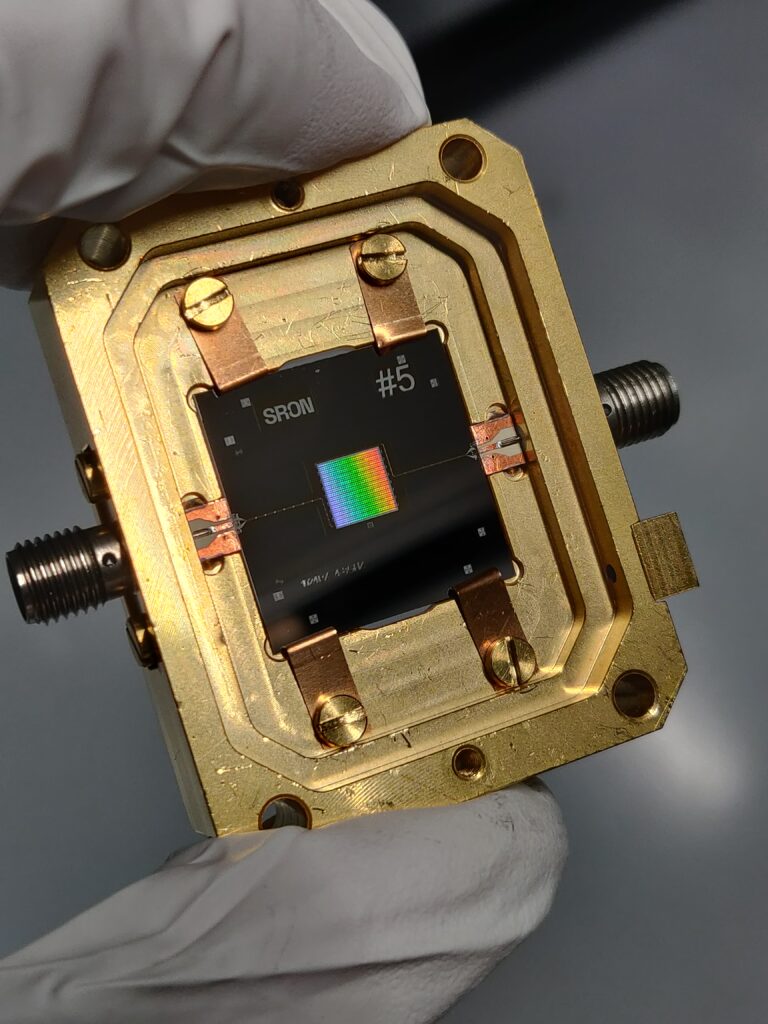
To make HWO much more sensitive than its predecessors, better detection technology than currently available is required. Current semiconductor-based detectors produce too much noise and require a grating or prism to distinguish colours. A research group at SRON led by Pieter de Visser is working on Kinetic Inductance Detectors (KIDs) for the wavelengths that planets reflect most: visible and near-infrared. KIDs detect almost every individual incoming photon and immediately determine its colour. This enables them to create a spectrum even from weak sources that send only one photon to our telescopes every few seconds.
tens of thousands of pixels
De Visser has now received an ERC Consolidator grant to continue the development of KIDs to a level that will be in line with the HWO schedule in 2030. In space terms: Technology Readiness Level 5. This means a camera with tens of thousands of KIDs, and just as many pixels. Each KID will then be able to determine the wavelength of a near-infrared photon with an accuracy of approximately 7 nanometres. That is 140 times smaller than the wavelength. ‘This requires a significant step forward in our understanding of detector physics,’ says De Visser. ‘And it will really push the KIDs to their fundamental limit. An additional challenge is to make the KIDs both sensitive and efficient, so that they detect more than 90% of the incident light.’
team
With the grant, the research group will strengthen its team over the next five years with two PhD students and a postdoc. There will also be engineering support for the nanofabrication of the detectors and the construction of the test setup. The group will also purchase a cryocooler that reaches almost absolute zero (-273 °C), to within fifty thousandths of a degree, plus the readout electronics.