



| Status | Active |
| Launch | 2019 |
| Space organisation | GroundBIRD Collaboration |
| Type | Microwaves (2.1 mm and 1.4 mm) |
| Orbit | Tenerife |
| SRON contribution to | Detectors |
Inflation
Cosmologists need a period of extreme inflation in the first 10-32 seconds after the birth of the Universe in order for their model to still be consistent with observations. The Universe would then have grown by a factor of 1027 in that short period of time.
Horizon problem
One of the problems encountered by the standard model of cosmology is that on the larger scale the Universe has the same temperature everywhere. No matter which direction we look, we see uniform radiation that an object of approximately 2.7 Kelvin would emit, so 2.7 degrees above absolute zero (-273.15 °C). In this so-called cosmic microwave background (CMB) we measure spatial variations in the order of one thousandth of a percent.
The problem is that areas on one side of the Universe have never been able to communicate with areas on the other side, because the speed of light is too low and the distances are too great. So how can their temperatures match so closely? Cosmologists call this the horizon problem. Only if extreme inflation occurred shortly after the birth of the Universe, could areas that were previously in contact with each other now be so far apart.
Flatness problem
The second problem with the standard model of cosmology is that the Universe appears to be exactly flat, with precisely the right density of matter and energy. By this we mean that the Universe is not spherical, where the angles of a triangle add up to more than 180 degrees, nor is it concave. Astronomers have drawn a triangle between the Earth and two points in the sky, and based on the CMB they can see with an accuracy of only 0.2% that the angles add up neatly to 180 degrees, as on a sheet of paper.
The problem here is that this flatness seems like an absurd coincidence, an impossible stroke of luck for humanity. If the density were slightly higher or lower, the Universe would collapse shortly after the Big Bang or fly apart before stars, planets and humans could form. The density, and therefore flatness, of the Universe must have a critical value so ridiculously precise that cosmologists speak of an impossible coincidence. The margin is an inconceivable 1 in 1062.
Inflation solves this problem too. The Universe may well have had a convex or concave shape right after the birth of the Universe, as long as this was followed by extreme inflation in which any curvature was eliminated. Think of an ant on a deflated balloon that clearly perceives ripples. When the balloon is inflated, the ant will perceive it as a flat surface.
Magnetic Monopole Problem
Theories of particle physics predict that large amounts of magnetic monopoles were produced right after the birth of the Universe. These are heavy particles with only one magnetic pole, contrary to the bipolar magnets we all know. Still, we have never found a monopole no matter how hard we look. Inflation solves this discrepancy between theoretical prediction and observation. By exponentially expanding space, inflation spreads out the created monopoles to such an extent that the chance of one ending up in our vicinity is practically zero.
Structure Formation Problem
Finally, there is a problem with the structure of the Universe, including all the galaxies, planetary systems and ourselves: it shouldn’t exist. If the Universe started out as a perfectly uniform chunk of energy, then how could there have been seeds for any type of structure? Also here inflation comes to the rescue.
At the smallest scales, we enter the realm of quantum mechanics, where there is no such thing as smoothness. The energy of each location in the Universe is constantly fluctuating. At the moment inflation took flight, those energy variations suddenly surged into macroscopic quantities and settled into the seeds for the structure of the Universe as we know it.
Cosmic microwave background
To find evidence that inflation actually took place, GroundBIRD is conducting measurements of the CMB. This radiation contains signatures from the period following the Big Bang. During the first few hundred thousand years, radiation could not move freely through the Universe because of the fog created by an excess of free-flying electrons and protons. After 380,000 years, the Universe had cooled sufficiently for electrons to bind to atomic nuclei, causing the fog to quickly dissipate.
From that moment onwards, radiation has been racing uninterrupted through the Universe in all directions. GroundBIRD therefore captures radiation from all directions that has been travelling throughout the full age of the Universe – 13.8 billion years. We call this the cosmic microwave background (CMB). It was emitted at wavelengths in the near-infrared, but the expansion of the Universe has stretched it to the wavelengths at which we observe it: microwaves.
Polarisation
The CMB is largely unpolarised. This means that all photons oscillate in random directions as they travel towards us. The same goes for sunlight. However, an external factor can give photons a slight preference for a particular oscillation direction. In the case of sunlight, it is the Earth’s atmosphere that influences the photons to oscillate in a certain direction. In other words, it becomes polarised. In the case of the CMB, the tiny irregularities that were present in the Universe are the factor that add a slight polarisation.
E-modes and B-modes
Depending on the origin of the irregularities, it could create two types of polarization in the CMB: E-modes and B-modes. While E-modes are created by both density fluctuations and gravitational waves, B-modes are created only by distortions of space due to gravitational waves. So B-modes in the CMB polarization show footprints of gravitational waves produced during cosmic inflation. By measuring the strength of B-mode, we can sense the energy scale of inflation and the underlying physics.
Since gravitational waves are tiny spacetime distortions, the strength of B-mode polarization is also expected to be very small. Estimated to be a fluctuation in the order of 10-9 K at its largest on top of the overall 2.7 K, the B-mode polarization has not been observed yet, despite many observational attempts so far.

Fast rotation
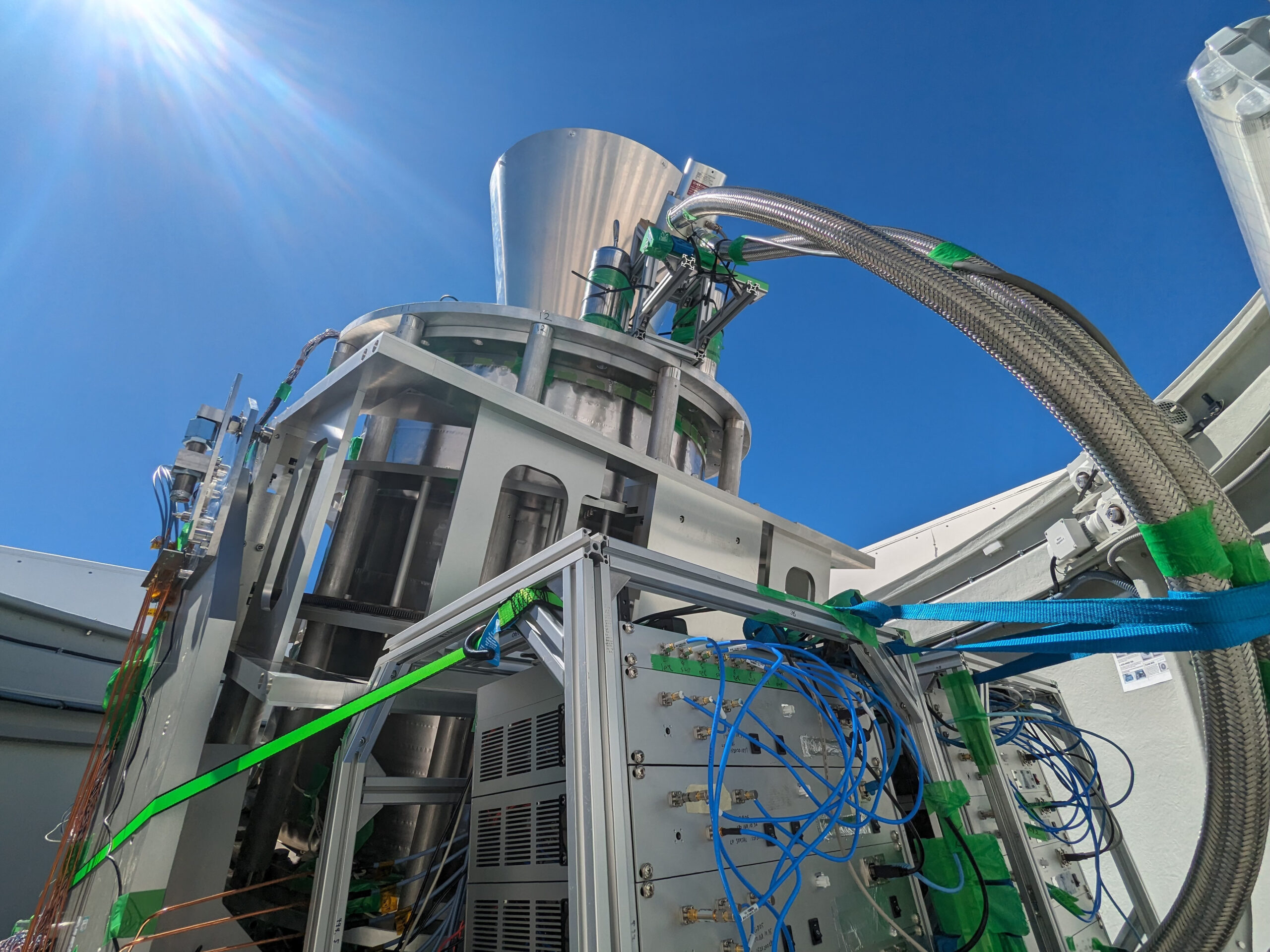
GroundBIRD is a ground-based telescope, meaning it is affected by disturbances in the Earth’s atmosphere. To counteract this, the telescope rotates around its axis twenty times per minute. Atmospheric disturbances, such as clouds, wisps of water vapour and warm air currents, pass by slowly and cause slow fluctuations in the measurements, like a low humming sound. The telescope’s fast rotation adds rapid fluctuations to this, like a high-pitched beep. A computer then filters the hum out of the data and retains the beep.
This trick requires detectors with a fast read-out. GroundBIRD rotates 120 degrees every second, while the pieces of sky that astronomers want to distinguish are smaller; a few tenths of a degree. Conventional bolometers process the incoming signal too slowly. SRON and TU Delft developed Kinetic Inductance Detectors (KIDs) that are fast enough. The fast rotation also allows us to see a large portion of the sky directions from which the CMB radiation comes.
Kinetic Inductance Detectors
KIDs are based on the physics principle of kinetic inductance. This is the manifestation of inertia in mobile charge carriers such as electrons. Kinetic inductance plays a role when a material cools to near absolute zero and becomes superconducting, thus offering no resistance to a flow of electrons.
Within a superconductor, most electrons exist in pairs, called Cooper pairs thereby bypassing the intrinsic resistance of the material. An alternating current accelerates and decelerates these pairs, causing them to generate kinetic inductance because the inertia of the Cooper pairs manifests itself; it requires energy for the alternating current to move the electron pairs back and forth. Think of a full shopping trolley that you have to push around a corner with a lot of force.
When radiation strikes a superconductor, the energy cascades through the material, breaking up thousands of Cooper pairs. A lower density of pairs means higher kinetic inductance. KIDs continuously measure the kinetic inductance of their material so that they know when radiation strikes.
GroundBIRD’s KIDs are designed to observe radiation with wavelengths of 2.1 mm and 1.4 mm, sorted by polarization sensitive antennas connected to KIDs. Multi-wavelength observation is crucial for separating the CMB polarization from other possible sources of polarized radiation, such as dust in the Milky Way or the intergalactic medium.