



Researchers from SRON and TU Delft have published the reference framework for their DESHIMA 2.0 spectrometer on the ASTE telescope in Chile. Although it has been collecting data since 2023, this laboratory analysis provides the missing key. Astronomers can finally verify their raw observational data and turn it into concrete discoveries about the early universe.
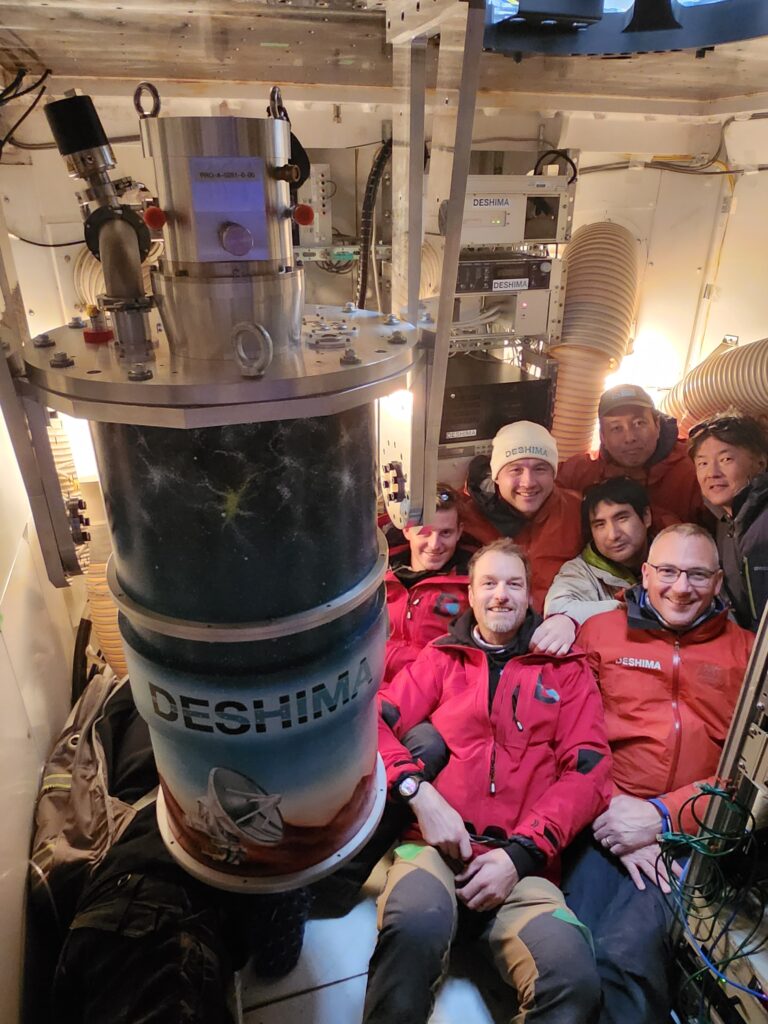
DESHIMA 2.0 captures terahertz radiation from distant, unknown galaxies, and is built on a single chip. Thanks to its broad frequency coverage between 200 and 400 GHz, it can determine a galaxy’s redshift – and therefore distance – in one glance. As if you would instantly get your favorite music station without having to scan all the channels. The instrument has successfully observed the cosmos for five months from the ASTE telescope in the Atacama Dessert. However, collecting data was only the first step.

To actually make scientific claims, astronomers must understand and prove the spectrometer’s properties. How exactly does the antenna respond to incoming light? What is its efficiency? Without that reference baseline, the captured signals cannot be reliably used for science.
In a publication in Astronomy & Astrophysics including first author Kenichi Karatsu (SRON), the researchers now provide that proof. They established the instrument’s performance in the laboratory. DESHIMA 2.0’s frequency coverage and real-world efficiency has been verified to be four times wider and higher than those of its predecessor.
TIFUUN
This successful validation officially greenlights the next major leap: the TIFUUN project. While the DESHIMA 2.0 chip serves as one single pixel, TIFUUN will combine dozens of these chips into a multi-pixel camera. Just like DESHIMA 2.0, each pixel can see distance based on the measured redshift. Therefore TIFUUN will serve as a 3D camera, consisting of ‘spaxels’ rather than ‘pixels’.
Publication
Karatsu, A. Endo, A. Moerman, S. J. C. Yates, R. Huiting, A. Pascual Laguna, S. Dabironezare, V. Murugesan, D. J. Thoen, B. T. Buijtendorp, S. Cray, K. Fujita, S. Hähnle, S. Hanany, R. Kawabe, K. Kohno, L. H. Marting, T. Matsumura, S. Nakatsubo, L. G. G. Olde Scholtenhuis, T. Oshima, M. Rybak, F. Steenvoorde, R. Takaku, T. Takekoshi, Y. Tamura, A. Taniguchi, P. P. van der Werf and J. J. A. Baselmans, ‘DESHIMA 2.0: A 200–400 GHz ultra-wideband integrated superconducting spectrometer’, Astronomy & Astrophysics