The idea: can kinetic induction help astronomy?

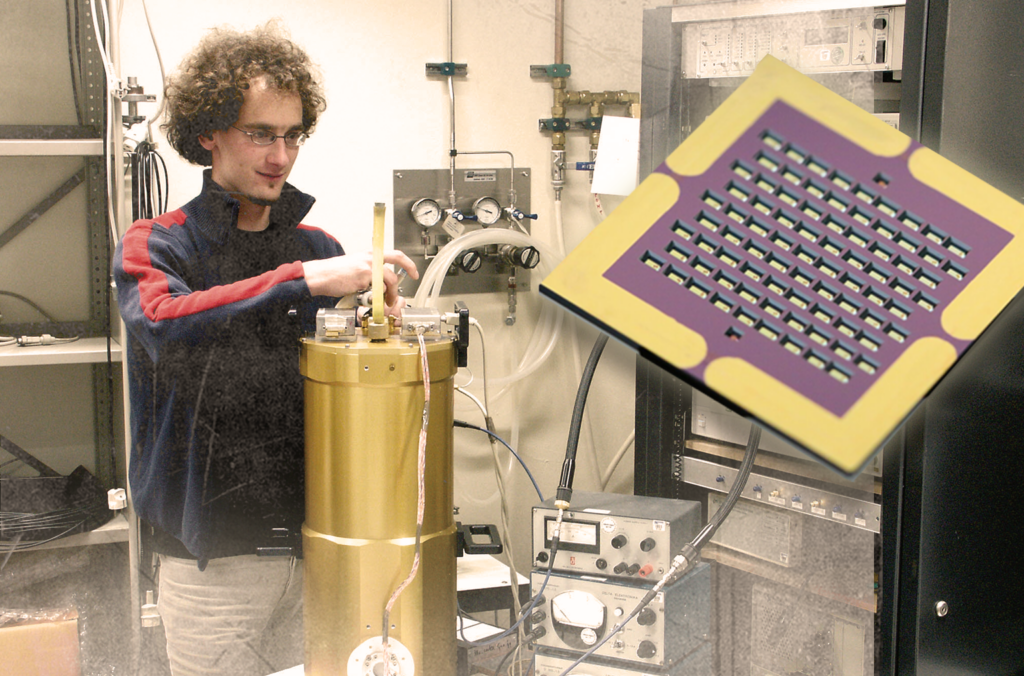
The new millennium had just begun when a group at the California Institute of Technology (Caltech) was pondering whether it would be possible to measure a light particle from the universe using the physical phenomenon known as “kinetic induction”. In the deeply cooled state of a superconducting system, a pair of two electrons swirls through the superconductor like dance partners, completely without resistance: a “Cooper pair”. But when a photon hits the cold superconductor, the pair is separated and the superconducting system slows down. This slowdown – the phenomenon of kinetic induction – could thus demonstrate the arrival of a light particle (photon).

The beginning: creating well-functioning resonators

“This idea promised not only super-sensitive detectors for radiation that is difficult to measure, but also the possibility of using them in large arrays with many pixels at the same time,” Jochem Baselmans realised. And those large arrays were precisely the bottleneck. At the time, he was a young researcher at SRON with his roots in Teun Klapwijk’s superconductivity group at Delft University of Technology. He immersed himself in the early research at Caltech for three months and took that knowledge back to SRON to commit himself to it for good. ‘I wanted to make new detectors for astronomy.’

“In 2005, we were able to purchase a cooling system with a small NWO grant,” says Baselmans, who has always worked closely with Delft University of Technology. “First, we wanted to make good microwave resonators that could accurately measure kinetic induction changes. Not to mention being able to determine that these changes were caused by photons (light particles) from the universe. That wouldn’t happen until much later.”

Radiation shielding: hundreds of meters of aluminium tape

‘We want to make detectors that can detect even the weakest radiation. But that also means you have to protect your system extremely well against radiation from the environment. Soon we would realise exactly how well… Even the smallest hole turned out to be a huge radiation leak.’

Even hundreds of meters of aluminium tape were not enough to seal this radiation leak. The development of stable resonators was therefore necessarily accompanied by the development of extremely radiation-tight cooler setups. This was almost a field of research in itself, producing its own valuable solutions and papers, which were also relevant in the field of quantum computers. “Because with every improvement in detector sensitivity, we discovered – unbelievable but true – more and more radiation leaks in the system that made themselves felt. In fact, we improved the setup again last year. Compare it with trying to feel the radiation from a candle on the moon with your hand; that is still 100 times more radiation than our cooler currently lets in.”

Read more

Crucial: the theory proves itself in practice!

Crucial detector experiments took place in the second half of the 2000s. ‘It was around 2008. With more funding and a new cooler at SRON, we were able to make increasingly better resonators from aluminium,’ Baselmans explains.

In the laboratory in Groningen, researcher Stephen Yates irradiated KIDs with weak millimetre and submillimetre radiation. As weak as the team ever hoped to be able to detect in the universe. He was able to control and increase the radiation power very precisely. He compared the noise in the results with exactly the noise that should occur when only radiation is at work, and nothing else: photon noise.

And what did he see? At the weakest signal presented, there was “detector noise”, but from just above that: photon noise straight out of the textbook! So the theory worked! The KID really is that sensitive and can accurately measure a very weak submillimetre photon signal!

Hitch: unexpected and unexplained noise in the system

At around the same time, the researchers were also working on a noise in the system that they couldn’t trace and hadn’t expected. And it bothered them. Beyond a certain temperature reduction, the system began to behave in a different way than expected. The readout electronics had such low power that they couldn’t possibly be responsible for this, could they? What were they doing wrong?

Pieter de Visser, also from Professor Klapwijk’s school, decided to take a thorough look at both the measured data and the models known to date, which the team uses to describe the energy management of the system and simulate its behaviour. ‘What exactly would you expect in these exact circumstances, according to theory?’ he wanted to check again. ‘And what could be responsible for the specific deviation from this in our measurement?’ Suddenly it occurred to him: ‘What if it’s not a design or measurement error? What if we’re not foing anything wrong?’


Read more

Breakthrough: quantum behaviour in the material itself, a limit to KID sensitivity

By exhaustively analysing the seemingly “strange” measurement data, De Visser and the team revealed that there was a pattern in the deviations. What if they compared those measured results with models of the behaviour of broken Cooper pairs, the quasiparticle dynamics?

This was it. The team revealed that in the superconducting aluminium material itself, Cooper pairs are broken by the signal with which we read out the KIDs. This causes the number of quasiparticles to fluctuate constantly. This noise, which could not be adequately explained by known noise sources, was not a design or measurement error, but was caused by fundamental quantum interactions of the material itself with the readout signal. This represented a breakthrough in our understanding, but also a fundamental limit in the sensitivity of an aluminium KID that detector developers must take into account.

Read more

Important bycatch: a quasi-particle research instrument

Imbued with this new insight, the team began to see more patterns and behaviours in the KID material that could be explained by quasiparticles. The KID was no longer just a promising technology for astronomical measurements, but also proved to be a good instrument for researching quantum behaviour in the material itself: quasiparticles, their lifetime, their recombination (when they form a new Cooper pair), and how they distribute themselves throughout the material.

Baselmans: ‘That was a huge breakthrough in solid-state physics, with enormous influence beyond the development of KIDs for astronomy. For example, this deep understanding of resonators is also crucial for researchers worldwide who are conducting fundamental research and researchers who are trying to create stable qubits for quantum computers.’

Read more

Rapid progress: better designs, new materials

For the KIDs team, this insight opened up a whole new world of possibilities for improving and applying KIDs. With greater knowledge of differences in quasiparticle behaviour in different materials, the researchers were able to exploit the properties of each material and tailor them to the detector design.

Dream application: what an astronomer wants with KIDs

Meanwhile, in Japan, an astronomer with cleanroom experience became fascinated by this in-depth work in the Netherlands. Akira Endo had been working on band 10 receivers for the ALMA telescope in Japan when he heard about KIDs. In 2009, he decided to leave his homeland to join the group in the Netherlands.

“I wanted to experience the process of generating whole new detector concepts from zero, that will shape the next scene in astronomy, and not only the progress of existing concepts. It’s just amazing to see how the group goes so deep into the fundamentals of solid state physics. I learned that this is the quickest – and only – path to really groundbreaking work, that shapes what people can do for decades.”

Akira’s dream is to have a far-infrared spectrometer camera to study ancient dusty galaxies. This has long been obscured by bottlenecks in technology. “You want a lot of pixels for a wide field of view, and you also want spectroscopy to identify elements, not just a flat photo. Then, if you also have a large bandwidth within a single observation, you can also observe redshifts well,” explains the astronomer. Redshift (the “Doppler effect”, but in light waves) allows an astronomer to see whether something is moving away from us or towards us in the universe. Because the universe is expanding, this is an indicator of how old the light is. The KIDs seem to be able to solve these bottlenecks. Akira applied for a NWO-grant to begin the development of the DEep Spectroscopic HIgh-redshift MApper, DESHIMA, and got it.

Solution: spectrometer on a chip

For spectroscopy, you need to break light down into colours (dispersion, as with a prism) so that you can measure the intensity of each colour (spectroscopy, as with a grating). SRON had already created a grating and prism in one: the immersed grating. This key technology made it possible to make the shortwave infrared modules of TROPOMI and Sentinel-5, for example, much more compact. It was after drinks with a departing student that it hit Jochem Baselmans how to do this with microelectronics, on a chip. Without sacrificing space to a light path with a grating or prism. ‘What if you made a series of filters on the chip, each sending its own narrow band of the signal to a KID…?’ He immediately called Akira. ‘Why don’t we put the whole spectrometer on a chip…’

Read more

The right moment

With the by now extensive knowledge about materials and how to manipulate their superconducting properties, it was also clear how. While the high sensitivity of an aluminium KID is ideal for detecting extremely weak signals in “difficult” radiation wavelengths, such as those below one millimetre, an antenna made of niobium titanium nitride (NbTiN) is excellent as a stable energy conductor to the detector without loss. It keeps out all kinds of noise that aluminium is less able to cope with.

“NbTiN is the ideal material for making the filters that Akira needed. Teun Klapwijk developed it in the 1990s for the ALMA and Herschel detectors, and with the KIDs it is once again playing a major role in astronomy,” says Baselmans.

Productive pioneering: manufacturing on ever higher levels

But now it was time to get building. That came with its own set of challenges. David Thoen: ‘We were venturing into unknown territory; this had never been done before. Teun Klapwijk always said: “Make as many mistakes as possible in as little time as possible”, and that’s what we did,’ he says.

“An aluminium detector or a 200-nanometre NbTiN antenna wire (roughly one-fourth the thickness of a human hair) cannot hang in the air. But where to put it on, keeping signals in the circuit unaffected by the substrate underneath?” One path we tried but then abandoned, for example, was micrometre crystalline silicon membrane. ‘Extremely thin, but also extremely fragile. Thinking back to the breaking crystalline silicon and the film on top of it can still get me nervous again,’ says Thoen. A more robust solution was found in membranes made of ‘amorphous’ material, i.e. without the fragile ordered crystal structure.

‘That was a journey that took years. We had to fine-tune the machines and test how those layers functioned at all colours and frequencies. But there were no test setups for far infrared to check the quality, so Akira Kenichi and I installed all equipment to an empty lab in TU Delft and established a way to efficiently test fabricated chips.’

Another important aspect of the manufacturing process that took years to develop is the uniformity of the layers on the chip, says Thoen. ‘You want the layers to have the thickness you intended in the design at every point on the chip, rather than them being thicker in the middle and thinner towards the edges of the chip, where they would have a different resistance. This is particularly important for larger arrays with thousands of KIDs on them.’ A new Evatec machine was used to achieve uniform resistivity across the entire wafer.

In addition to uniformity, the control of line thicknesses and detailing of patterns in the chips also ramped up. ‘We now make line widths of 250 nanometres and can, for example, create almost perfectly right-angled structures, while the results are increasingly predictable. The quality and reproducibility of what we make is enormous. We are in complete control of what we are doing.’


Read more

The first measurement: ancient starlight

As chip manufacturing and instrument development moved closer to Akira’s dream instrument, Akira Endo secured a spot under the Japanese ASTE telescope in Chile. First for DESHIMA, in 2017, and then for DESHIMA 2.0 in 2023. Akira Endo remembers every step in the development process vividly, from Jochem’s Eureka phone call to the goosebumps he got at the “first light” with DESHIMA in 2017.

‘The moment when ancient light from unimaginably long before our birth, for the first time, hits our superconducting detector and breaks up a Cooper pair in it. In the chip, which we developed ourselves from a block of niobium titanium nitride and aluminium. Like blood flowing through your body and powering your organs.’

The instrument the astronomer dreamed of is now also nearing reality. With an ERC grant for TIFUUN, the leap can be made from proof-of-concept of the on-chip spectroscopy of DESHIMA and DESHIMA 2.0 to full 3D imaging of the (ancient) cosmos in the until now tricky TeraHertz part of the far infrared.

Read more

Practical hurdles: alignment in a remote desert

During the operational phase with the DESHIMA prototype, the team encountered a rather practical obstacle: the viewing direction of the super-sensitive chip in relation to the sky was not optimal. If such a sensitive instrument has parts of the instrument cabin or its own (uncooled) optics in its field of view, even if only slightly, in addition to a cold sky, this has a significant impact on how much of the incident light can be utilised. ‘Adjusting that, screw by screw, is a time-consuming job. And because of the high altitude at which ASTE is located in the remote Atacama Desert in Chile, it is not easy to work without breaks,’ explains Kenichi Karatsu, who worked on a solution. In DESHIMA 2.0, the warm instrument optics were placed on a motor-driven hexapod that could be remotely controlled via the internet. With a light switch that quickly switches between the cold sky and a warm source, researchers can also remotely monitor whether the cold sky is in view or – if the temperature difference between the light sources is incorrect – whether the tripod needs to be adjusted.

The leap into space: NASA Probe call and PRIMA

In 2022, NASA issued a call for proposals for the so-called Probe mission. Meanwhile, the sensitivity of KIDs has increased to such an extent that KIDs can see the background radiation of the universe. Such a sensitive detector could justify the costs of a space mission with a large supercooled mirror. The concept for a far-infrared mission based on KIDs, the PRIMA mission, is one of two selected mission concepts whose proposers are allowed to demonstrate in a phase A study that their mission will yield the most for astronomy and, moreover, can be realised within the set time and budget.

Previous detectors were unable to exploit the advantages of such a relatively expensive mirror. This has led to a so-called “Terahertz gap” in astronomy. At this frequency, far infrared, astronomers have hardly been able to study the universe. ‘With the combination of KIDs and a large cold mirror, we will, for example, be able to see the dust in the very first galaxies for the first time,’ says Baselmans. ‘And who knows what else. This is the last unexplored territory in astronomy.’

Read more

Further development: optical and near-infrared

While the work to bridge the difficult TeraHertz gap brought the KIDs close to a space mission, the group also worked steadily on developing the KIDs for optical and near-infrared wavelengths. This paves the way for precisely determining the composition of exoplanet atmospheres. The shorter wavelength and higher energy of optical and near-infrared compared to far-infrared do, however, present new challenges. Pixels need to be smaller, which in turn brings all kinds of manufacturing challenges. It also means new design challenges, such as a new quest to control noise and also to find new materials and their quasiparticle behaviour. But as super-sensitive detectors, capable of measuring the energy of each photon, these KIDs could be the ticket to future missions such as an instrument under ESO’s ground-based Extremely Large Telescope and NASA’s space-based Habitable Worlds Observatory. It would be a world first to characterise small Earth-like exoplanets.

Read more

Looking forward: opportunities or maybe even ‘open facilities’?

A very interesting new opportunity is the Dynaverse project, a German project to build a very large spectrometer for the Fred Young Sub-millimetre Telescope, located on a mountain next to ASTE, APEX and ALMA and 5,600 metres above sea level, using the knowledge and expertise of the KID team.

The combination of fundamental research, driven by applications in astronomy, has already attracted many diverse talents to KIDs research. Akira Endo sees how KIDs inspire students at TU Delft. ‘Because they experience the entire process, from NbTiN block to measurement and everything in between.’

De combinatie van fundamenteel onderzoek, gedreven door toepassing in de astronomie, heeft al veel uiteenlopende talenten naar het KIDs onderzoek toe getrokken. Akira Endo ziet op de TU Delft hoe de KIDs studenten inspireren. “Omdat ze het hele proces van NbTiN blokje tot meting en álles daartussen meemaken.”

Hij droomt al een nieuwe droom waarin de afstand tussen de sterrenkundige en het meetinstrument verdwijnt. “Wat als in de toekomst het ontwerpproces en de mogelijkheden van de hardware samen in open source ontwerpsoftware te vangen zouden zijn… Waarmee sterrenkundigen zelf een detectorontwerp zouden kunnen maken voor een specifieke onderzoeksvraag? Dan gaat naast hogere gevoeligheid en grotere bandbreedte ook een veel groter aantal creatieve breinen een rol spelen.”

Het avontuur van de ontwikkeling van KIDs lijkt ook na 20 jaar nog lang niet voorbij.

Read more