



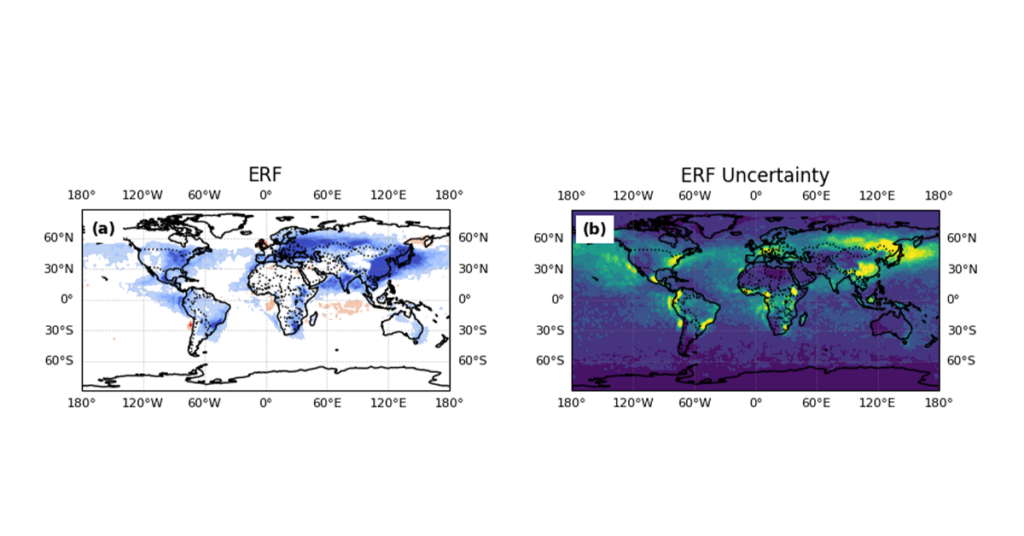
Aerosols have a net cooling effect on the climate, but to what extent is highly uncertain in climate models. The Dutch SPEXone instrument on NASA’s PACE satellite is gathering data to decrease this uncertainty. SRON’s SPEXone team has now calculated the cooling effect for millions of possible scenarios using machine-learning.

The earth is warming up because of anthropogenic greenhouse gases such as CO2 and methane. This would be even more dramatic if it weren’t for aerosols, for example urban pollution, smoke from biomass burning, ash and desert dust. Aerosols have a net cooling effect on the climate. However, because they are polluting the air leading to over 4 million premature deaths per year, regulations are put in place leading locally to effective reduction of human-made aerosol emissions.

margin of 0.2 to 1.0 °C
For policymakers it is vital to know as accurately as possible what the effects of greenhouse gases and aerosols are on the global temperature. It helps them create a pathway towards the goal of no more than 1.5 °C or a maximum of 2.0 °C warming compared to pre-industrial times. The main uncertainty lies with aerosols, with a cooling effect that could be as small as 0.2 °C or as large as 1.0 °C. Better constraints on aerosol uncertainties allow more confident assessments of whether current policies keep us on track for 1.5–2 °C warming limits.
SPEXone
In 2024, NASA launched the PACE satellite including the Dutch instrument SPEXone, which measures various properties of aerosols in the atmosphere, such as type, size, reflectivity and influence on cloud formation. Clouds also have a net cooling effect. Scientists will use SPEXone data to decrease the uncertainty caused by aerosols in climate models.
millions of climate model simulations
Before reducing this uncertainty, scientists need to figure out the ins and outs of where the models go wrong. SRON scientists have performed millions of climate model simulations to identify the key contributors to model uncertainty in aerosol radiative forcing: natural ocean emissions, large fires, and sulfur from fossil fuels. With SPEXone measurements the team will now focus on these uncertain factors, narrowing down the uncertainty margins of the net effect of aerosols, helping make climate projections more reliable, including on the regional level.
Publication
Yusuf A. Bhatti, Duncan Watson-Parris, Leighton A. Regayre, Hailing Jia, David Neubauer, Ulas Im, Carl Svenhag, Nick Schutgens, Athanasios Tsikerdekis, Athanasios Nenes, Muhammed Irfan, Bastiaan van Diedenhoven, Ardit Arifi, Guangliang Fu, and Otto P. Hasekamp, ‘Uncertainty in aerosol effective radiative forcing from anthropogenic and natural aerosol parameters in ECHAM6.3-HAM2.3’, Atmospheric Chemistry and Physics