| TELIS |
|
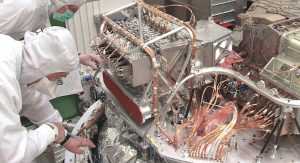
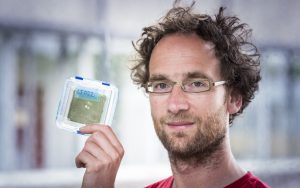
Atmospheric research from a balloon gondolaTELIS (Terahertz and submillimeter Limb Sounder) is an instrument designed to fly on a stratospheric balloon gondola, together with the instrument MIPAS-B. From a flight altitude of 30-40 km, it scans the atmosphere with 1-2 km height resolution and produces profiles of various molecules, with unprecedented accuracy, such as: O3, H2O and its isotopes, Hcl, ClO, HOCl, NO2, N2O, HNO3, OH, and BrO. In particular the cryogenic sensors of TELIS allow for the measurement of H2O isotopes, which sheds light on the origin of water in the statosphere. Together with the MIPAS-B instrument TELIS will be an excellent measurement platform for atmospheric science. There are several ways to measure trace gases in the Earth's atmosphere. One can use absorption lines in reflected solar light, as employed by GOME, Sciamachy and OMI. It is also possible to use emitted light by molecules in the thermal infrared (5-15 micron wavelength), used by e.g. the ENVISAT/MIPAS instrument, or in the far infrared and submillimeter wavelengths (100-1000 micron wavelength) where TELIS measures. To measure spectra in the sub-mm with high resolution and low noise it is required to employ very sensitive cryogenic mixer-detectors operating at 4 Kelvin. Equivalent to an FM radio, the atmospheric radiation is converted from sub-mm and THz frequencies (300 to 2000 GHz) to the 5-7 GHz band. At these frequencies, the signals are amplified and a spectrum is taken. From the spectrum we can determine which and how many molecules are within the sight of TELIS. TELIS has three channels: a 500 GHz receiver developed by the British Rutherford Appleton Laboratory; a 480-650 GHz receiver developed by SRON and a 1800 GHz receiver developed by the German Space Agency DLR. The SRON receiver is the first application of a Superconducting Integrated Receiver (SIR), where the mixer and the local oscillator needed for the mixing process are integrated on one single chip of 4x4 mm2. The development of the SIR is a collaboration between SRON and the Institute of Radio Electronics and Engineering (IREE) in Moscow. It had its maiden flight in 2008 in Teresina, Brazil. During the ascent of this flight the instrument became much colder than anticipated and tested, leading to several instrumental failures. A leak in the cryostat was the most severe and prevented the recording of spectra. The next flight is scheduled for early 2009 in the polar circle from Kiruna, Sweden. A phonon cooled Hot Electron Bolometer Mixer (HEBM) to be applied in the 1.8 THz channel of DLR is currently under development at SRON. The devices recently produced and tested at SRON have shown state-of-the-art noise temperature in combination with a large bandwidth. More on TELIS can be found under the EOS-TELIS page. |
|